

Your mattress can contribute to morning back pain — most credibly when the pain is worst on waking and eases once you move around, and when the bed is sagging, too soft, or too firm. But it is rarely the whole story, and it won't fix inflammatory or structural spine disease. Back pain is common to start with: 39.0% of U.S. adults reported back pain in the past three months (CDC, 2019). The useful question isn't "which mattress?" — it's whether your mattress is even the suspect.
Key takeaways
- Mattress-suspect pattern: pain worst on waking, eases as you move, plus a bed that sags or fights your spine.
- Look-elsewhere pattern: constant, radiating, worse at night or lying down, or with fever, numbness, or weight loss — see a doctor.
- Medium-firm is better supported than very firm for nonspecific low back pain, but it's not a universal rule.
- Give a new mattress about 4–8 weeks — studies measured outcomes over 28 to 90 days, not one night.
- A new mattress can improve comfort and sleep, but won't treat disc disease, stenosis, or inflammatory arthritis.
Morning back pain (waking back pain) is discomfort or stiffness in the back that is noticeable on waking and typically eases within an hour of getting up and moving. Spinal alignment while sleeping is keeping the natural curves of your spine in a neutral position — the same shape you'd have standing well — so no single region is compressed or overextended overnight. Competitors mostly stop at "buy medium-firm." This guide separates the mattress may be contributing from the mattress is the cause — and tells you who a new bed won't help. If you're still deciding where to start, our plain-English guide to choosing the right mattress pairs well with the triage below.
Why does my back hurt more when I first wake up but feel better once I'm up and moving?
Overnight stillness lets muscles stiffen and circulation slow, so tissues feel tight on waking; movement restores blood flow and eases it. Hours in one position allow low-grade stiffness to build, and the first movements of the morning can feel achy as tissues start moving again. For most people this is ordinary mechanical soreness, not a sign of disease.
The pattern itself is a clue. Wake-worse, move-better points toward a mechanical cause — where sleep surface and posture can matter. But there's an important exception competitors skip: morning stiffness that lasts more than about 30 minutes and improves with exercise rather than rest is a recognized flag for inflammatory back pain, such as ankylosing spondylitis (Ubie Health, 2026). That's a diagnostic clue, not proof — but it changes the plan entirely, because no mattress treats inflammatory disease.
Bottom line: brief morning stiffness that fades once you're up is a mattress-suspect pattern. Prolonged morning stiffness that eases with activity, not rest, is a doctor's question — not a shopping question.
Can my mattress be the cause of my morning back pain, or is it something else?
Yes, a mattress can contribute, but it is rarely the only cause. Use the wake-worse/move-better pattern plus a visibly sagging or ill-fitting bed to decide whether the mattress is even the suspect. Sleep surface, firmness, and spinal alignment can affect pain — and poor sleep itself is associated with worse back-pain outcomes, so the relationship runs both ways.
A 2021 systematic review of 39 studies (Caggiari et al.) concluded medium-firm surfaces are associated with better comfort, sleep quality, and spinal alignment for nonspecific chronic low back pain — while noting the underlying trials are small and heterogeneous. The link runs both directions: a 2024 systematic review by Silva et al. found baseline poor sleep was associated with non-improvement in low back pain long-term (odds ratio 1.55), and non-improvement in sleep with non-improvement in pain short-to-moderate-term (OR 3.45). Note the language: associated with, never cures.
The Mattress-Suspect vs Look-Elsewhere triage: which is better?
| Signal | Mattress-suspect | Look elsewhere (see a doctor) |
|---|---|---|
| Timing | Worst on waking, eases as you move | Constant, or worse at night / lying down |
| The bed | Visibly sagging, too soft, or too firm | Bed is fine and supportive |
| Spread | Localized low-back ache or stiffness | Radiates below the knee; numbness or weakness |
| Company it keeps | No systemic symptoms | Fever, unexplained weight loss, bowel/bladder changes |
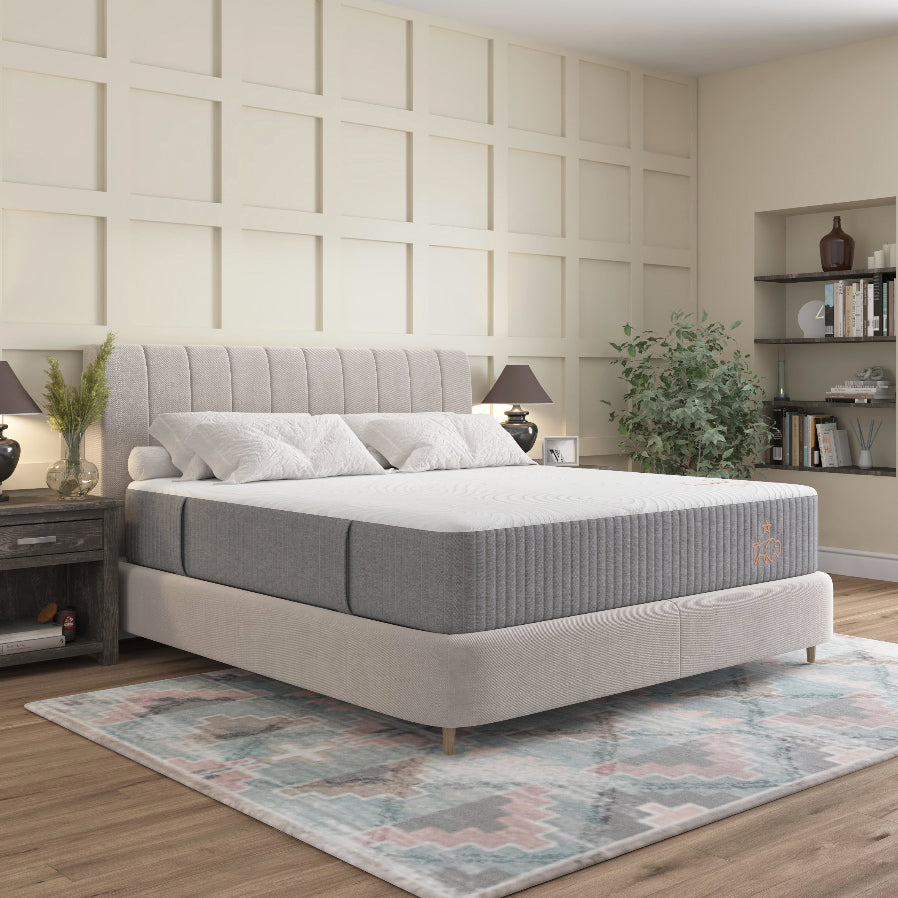
If the pain reads as mattress-suspect and your bed fails on alignment, a medium-firm hybrid is a reasonable starting point — our fiberglass-free Luxury Hybrid is built to hold spinal alignment while still contouring at the hips and shoulders. The honest caveat: firmness fit still depends on your body and sleep position, which is why the next two sections matter before you buy anything.
Is a firm or medium-firm mattress better for lower back pain?
Medium-firm is better supported than very firm for most people with nonspecific chronic low back pain, but it is not a universal rule. The clearest trial evidence and the largest reviews converge on medium-firm as the sensible default — not because it's magic, but because it balances support and pressure relief. As Spine-health puts it plainly, "A medium-firm mattress provides support for the spine" (Spine-health).
What the primary evidence actually says
| Study | Design & sample | Finding | Honest limit |
|---|---|---|---|
| Kovacs et al., 2003 | Randomized, double-blind trial, n=313, chronic nonspecific LBP, 90 days | Medium-firm beat firm for pain in bed, pain on rising, and disability (odds ratios ~2.36 / 1.93 / 2.10) | Compared medium-firm vs firm — not mattress vs no mattress |
| Caggiari et al., 2021 | Systematic review, 39 studies | Medium-firm favored for comfort, sleep quality, alignment | Underlying studies small and heterogeneous |
| NIH/NCBI, 2022 | Evidence review, 9 studies (2 RCTs) | Intermediate firmness better than firm for disability | Small evidence base; long-term effect unclear |
| Harvard Health, 2021 | Survey, n=268 with LBP | Very hard mattresses had the poorest sleep quality | Survey, not a controlled trial; comfort is individual |
Bottom line: "firmer is always better" is a myth the data doesn't support. Very firm beds preserve support but can add pressure at the shoulders and hips; the best-supported middle ground is medium-firm. If you'd like to weigh the two builds side by side, our Original Foam vs Luxury Hybrid comparison lays out the trade-offs.
How do I tell whether my mattress is too soft or too firm for my back?
Too soft: your hips sink and the low back hammocks. Too firm: you get pressure-point pain at the shoulders and hips. The target in between is neutral alignment — your lying spine holds roughly the same shape as your standing spine.
Run this quick check tonight and tomorrow:
- Too-soft tells: a visible dip where you sleep, hips clearly lower than shoulders, worse pain when lying down and on rising.
- Too-firm tells: sore shoulders or hips, numb arms, the sense you're "lying on" the bed rather than "in" it.
- Neutral tells: you can slide a hand into the low-back gap with light resistance — not a wide gap, not none.
- The real-world test: Harvard Health advises judging a mattress by how you feel after sleeping on it overnight away from home, not by a few minutes in a showroom.
One honest caveat: soft isn't automatically bad and firm isn't automatically good. The right answer shifts with your body weight and — as the next section shows — your sleep position.
Does my sleeping position change which mattress firmness I need for back pain?
Yes. Side sleepers need pressure relief at the shoulders and hips, back sleepers need medium-firm support to hold the lumbar curve, and stomach sleepers need firmer support to stop the hips sinking. Position changes the mechanics, so it changes the ideal firmness.
| Position | Mechanical need | Firmness lean | Pillow move (Mayo Clinic) |
|---|---|---|---|
| Side | Distribute pressure at shoulder & hip; stop torso from sagging | Medium to medium-firm with contouring | Pillow between the legs |
| Back | Preserve the lumbar curve; limit sink | Medium-firm | Pillow under the knees |
| Stomach | Stop hip sink and lumbar overextension | Firmer support | Thin pillow; consider a slim pillow under the hips |
"Flexing your knees and having a pillow between your legs can help align your spine, pelvis and hips." — Mayo Clinic, Sleeping positions that reduce back pain
Side and back sleepers who want contouring plus support are the natural match for the medium-firm Luxury Hybrid. Firmer-support sleepers — many stomach sleepers, and heavier back sleepers who feel a foam bed give way — often do better on the more supportive Original all-foam build. Fair warning: the position rules are consistent expert guidance plus small experimental studies, not head-to-head RCTs for every position, so treat them as a starting lean, not a prescription.
Can an adjustable base or a new sleep position relieve back pain without buying a whole new mattress?
Sometimes. Changing position or adding an adjustable base may ease self-reported pain for some people, but the effect is small and perceived rather than proven in objective sleep data. It's a reasonable, lower-cost first step before replacing a whole mattress.
A 2025 Oxford Academic report (42 participants, 1,298 nights) found an adjustable base was associated with less self-reported back pain versus sleeping flat — about a 28% drop overall and 27% in the back-pain subsample — but no objective sleep change. On position, a 2025 review of six studies found supine and supported side-lying were associated with lower low-back pain, while prone (stomach) sleeping was linked to more lumbar strain.
The honest read: this is supportive, not definitive, evidence — the wording is "may help," not "fixes." If your mattress is otherwise sound but you want elevation to ease pressure, exploring an adjustable base is a sensible move before a full replacement. And if pain is severe, radiating, or comes with numbness, position tricks are not a substitute for a doctor.
How old does a mattress have to be before it causes back pain?
There's no fixed age. What matters is lost support and visible sagging, not the calendar; six to ten years is a maintenance rule of thumb, not a pain threshold. A well-built bed can hold up longer, and a poorly-built one can sag sooner, depending on materials, body weight, and wear.
"If you're waking up with pain that is worse in the morning, then it might be caused by your mattress, especially if it's more than five years old." — Jennifer O'Connell, MD, spine and sports medicine physiatrist, quoted by Wirecutter
Check for degradation, not birthdays: a body-shaped dip that doesn't spring back, uneven firmness across the surface, a "roll into the middle" feel, or coils/edges you can feel through the top. Those signs mean the surface has stopped holding your spine neutral — which is the real trigger. Buying blind is easy to get wrong, so it's worth reading the common mattress-buying mistakes before you replace anything.
Will a new mattress help if I already have a diagnosed chronic back condition?
It may improve comfort and sleep, but a new mattress won't treat structural or inflammatory disease — that's who this is not for. The mattress evidence is strongest for chronic nonspecific low back pain, not for disc disease, spinal stenosis, inflammatory arthritis, or nerve compression.
The distinction matters because the mechanism is limited. A better-fitting bed improves load distribution and helps hold neutral alignment — it does not shrink a herniated disc or calm an inflammatory process. The NIH/NCBI evidence review found only a small base of studies, and the landmark Kovacs trial compared medium-firm against firm — not a new mattress against no change.
Who a mattress upgrade genuinely helps: people whose current bed is sagging, too soft, too firm, or mismatched to their position. Who it won't fix: anyone whose pain is driven by a diagnosed structural or inflammatory condition — a new bed may help you sleep, but it isn't treatment. When in doubt, get the diagnosis first.
How long should I test a new mattress before deciding it's helping or hurting my back?
Give it about 4–8 weeks. Studies measured outcomes over 28 to 90 days, so judge by trend, not a single restless night. A new surface changes how your body loads overnight, and it can take weeks for that to settle into your back and sleep quality.
The trial evidence backs the timeline: reviewed trials tracked symptoms over 28 to 90 days, with daily symptom logs rather than snap judgments. Track three signals across the first month: your pain trend, your sleep quality, and next-day stiffness. If all three are improving, the bed is likely a good fit. If they're clearly worse or unchanged after about four weeks, that's a fair point to reassess firmness and support — a short adjustment period is normal, so don't bail on night one.
Could a non-toxic, breathable mattress matter if I wake up sore AND overheated?
Breathability helps heat and non-toxic materials address emissions and safety — but neither treats back pain directly. Be clear on what each problem is: heat is a sleep-quality issue, and back pain is a support issue. They can overlap in one restless night without sharing a cause.
On heat, the evidence is consistent: a 2024 systematic review found 81% of 36 articles linked higher temperatures to poorer sleep, and a 2020 study (Xiong et al.) found each 1 K rise in bedroom temperature was associated with about a 1% drop in sleep efficiency. So breathable materials genuinely help a hot sleeper rest better.
On materials and safety, certifications answer a different question — emissions and chemical content, not pain. CertiPUR-US certifies that foam emits VOCs below 0.5 parts per million and excludes formaldehyde, certain flame retardants, and heavy metals — but it certifies the foam only, not the whole mattress. Nest & Wild is 100% fiberglass-free (most competitors aren't), uses CertiPUR-US foams, GreenGuard Gold glue, and OEKO-TEX certified components, and is built in Tupelo, Mississippi. For a hot, safety-conscious sleeper, the honest recommendation is a breathable, non-toxic setup: pairing the fiberglass-free hybrid with our breathable Bamboo Sheet Sets targets heat and emissions — while support and firmness, not certifications, are what address the ache. If airflow is your main complaint, our guide on how airflow materials keep you cool digs deeper.
When is back pain after sleeping a sign I should see a doctor?
See a doctor if pain is constant or intense, worse at night or lying down, radiates below the knee, or brings numbness, fever, or weight loss. These are patterns that behave unlike ordinary mechanical soreness from sleep posture or an unsupportive bed.
Per Mayo Clinic and NHS red-flag guidance, get evaluated if your back pain:
- Is constant or intense, especially at night or when lying down
- Spreads down one or both legs, particularly below the knee
- Causes weakness, numbness, or tingling
- Comes with new bowel or bladder changes (seek urgent care)
- Follows a fall, blow, or other injury
- Arrives with fever, night sweats, or unexplained weight loss
- Hasn't improved after about a week of home care
This list isn't here to sell you anything — it's here to make sure you don't spend on a mattress while a treatable condition goes unchecked. When the pattern is a red flag, the next step is a clinician, not a checkout page.
Common questions about morning back pain and mattresses
Are memory foam, hybrid, or latex mattresses better for back pain, and does the material really matter?
Firmness and support matter more than the material label. The 2021 review of 39 studies pointed to medium-firm over very firm, and Harvard Health found no clear overall winner by type. Material affects how you get contouring and temperature — pick support first, material preference second.
How much should I expect to spend on a mattress that genuinely supports my back?
Consumer Reports notes many high-performing mattresses land around the $1,000 range, with premium models near $2,000 or more. Price is a weak predictor of back support — a bed that holds your spine neutral matters far more than the sticker.
Do my pillow and how I stack it matter as much as the mattress?
For neck pain, yes — a 2021 meta-analysis found certain pillow designs reduced neck pain and waking symptoms, with shape and height as the key variables. For low back pain specifically, evidence is thinner; a pillow helps mostly by keeping your neck and upper spine neutral, not by fixing lumbar pain.
What non-mattress things could be causing my back to hurt after sleeping?
Mayo Clinic lists muscle or ligament strain, bulging or ruptured disks, arthritis, and osteoporosis among common causes. Daytime load matters too: the WHO — which counted 619 million low-back-pain cases in 2020 — names low activity, smoking, obesity, and heavy physical work as risk factors that don't change when you swap beds.

Your next step, in one rule
If your pain is worst on waking, eases as you move, and your bed sags or fights your spine, the mattress is a fair suspect — start with a medium-firm surface or an adjustable base. If the pain is constant, radiates below the knee, or arrives with fever, numbness, or weight loss, skip the shopping and see a doctor. For the mattress-suspect crowd who also sleep hot and care about clean materials, the fiberglass-free, CertiPUR-US Luxury Hybrid built in Tupelo, Mississippi is a reasonable place to begin — with the honest caveat that firmness fit still depends on your body and position. Prefer a lower-cost first move? Explore the Adjustable Base before replacing the whole bed. This article is educational and not medical advice — for diagnosis or persistent pain, talk to a clinician.