

Parents who've seen the headlines about mattresses "leaking fiberglass" want one plain answer: is paying more for a fiberglass-free bed actually worth it for a kid's room? Yes — for most families, mainly as risk reduction if a cover is ever unzipped, torn, or worn. California's Department of Public Health warns that fiberglass released from a mattress can irritate the eyes, skin, nose, throat, and lungs. But "fiberglass-free" is not the same as "fire-safe," and it doesn't by itself mean non-toxic.
Key takeaways
- The real benefit is contamination prevention: fiberglass-free removes one specific irritant if a kid's cover ever gets opened, torn, or worn — the moment public-health agencies say exposure happens.
- Fiberglass is never legally required: U.S. mattress law is a performance standard, so compliant beds can use wool, silica/rayon, or treated fibers instead.
- Three claims, three meanings: fiberglass-free ≠ fire-safe ≠ non-toxic. Verify each one separately.
- Reframe the question: not "fiberglass or not?" but "which fire barrier, how is it contained, and how do I verify it?"
- Skip the urgency if an intact-cover mattress stays undisturbed by an adult — the risk rises when kids handle, spill on, and outgrow the bed.
Is a fiberglass-free mattress actually worth it for families with kids?
Yes, for most families — mainly as risk reduction if a cover is ever unzipped, torn, or worn. But it isn't automatically "safer overall" or "fire-safe," and it doesn't guarantee non-toxic materials. The benefit is narrow and real: it removes one specific contamination hazard from rooms where covers get handled, spilled on, and outgrown.
Fiberglass in a mattress is a fine glass-fiber textile used as a low-cost fire barrier that helps the bed pass federal open-flame tests. It's usually hidden beneath the cover as an inner barrier or "sock." The problem isn't an intact, sealed mattress — it's what California's Department of Public Health documents when a barrier gets exposed: a case where a child's skin and breathing were harmed by fiberglass that escaped from a mattress.
That's why the smarter question isn't "fiberglass or not?" It's which fire barrier does the brand use, how well is it contained, and how do I verify it? Our fiberglass-free mattress hub works through that reframe in depth.
Who this is NOT urgent for: an adult-only mattress with an intact, sealed cover that no one unzips. In that case the fibers stay contained and the extra spend buys mostly peace of mind. In a kid's room — where a curious child might tug a zipper or a spill soaks the cover — the calculus flips.
What does a genuinely fiberglass-free build look like in practice? Our all-foam Original mattress is one worked example: 100% fiberglass-free, built with CertiPUR-US foams, GreenGuard Gold-certified glue, and OEKO-TEX-certified materials, made in Tupelo, Mississippi. That's the verification checklist met on paper — not a marketing word on a hangtag.

What exactly is fiberglass doing inside a mattress?
Fiberglass is a fine glass-fiber textile used as a low-cost fire barrier that blocks flame from reaching the foam core — one of several ways to meet U.S. fire rules, never the only one. It's typically sewn into an inner sock beneath the outer cover.
Here's the regulatory "why" most articles skip: U.S. mattress law is a performance standard, not a materials list. The Consumer Product Safety Commission enforces two rules — 16 CFR Part 1632 for smoldering (cigarette) ignition and 16 CFR Part 1633 for open flame. Part 1633 caps the fire a mattress can generate rather than dictating one fiber; a mattress set must keep peak heat release at or below 200 kW and total heat release under 15 MJ in the first 10 minutes of a 30-minute test.
The CPSC's own guidance states the standard "does not specify individual components such as FR foams, barriers, or thread." — U.S. Consumer Product Safety Commission, mattress Q&A
Bottom line: fiberglass is a cost choice, not a legal requirement. Compliance is about fire behavior, so brands can and do meet it without any glass fiber. If you want the mechanics of how alternative barriers actually stop a flame, that's the subject of our companion guide on flame barriers.
Is a fiberglass-free mattress actually safer for kids, or is it just marketing?
It's safer mainly because it removes a known irritant if a cover is damaged or removed — not because every fiberglass mattress is dangerous in normal, intact use. The hazard is an exposure mechanism, not an inherent bedtime threat from a sealed bed.
The distinction matters. California's Department of Public Health states plainly that contact with fiberglass can irritate the eyes and skin, and breathing tiny pieces can irritate the nose, throat, and lungs. Poison Control is equally direct that human exposures occur when mattress covers are unzipped or removed — the release event, not the bed itself, is the trigger.
On the toxicology, stay measured. The federal ATSDR notes synthetic vitreous fibers can irritate the eyes, skin, and upper respiratory tract, and that no studies exist on whether exposure affects fetal, infant, or young-child development. That's irritation and unknowns — not proven long-term disease. Anyone claiming fiberglass "causes" childhood illness is going past the evidence.
So is it marketing? "Fiberglass-free" is only meaningful if the bed still passes flammability rules and the brand discloses the barrier that replaced it. A vague "fiberglass-free" claim with no disclosed substitute and no certification is marketing. A disclosed build with named certifications is a genuine material choice.
Fiberglass-free vs fire-safe vs non-toxic: what's the difference?
They're three different claims: fiberglass-free means no glass fiber, fire-safe means it passes flammability tests, and non-toxic means low-emission verified materials — none guarantees the others. Most articles blur them, and that's where buyers get misled.
| Claim | What it guarantees | What it does NOT tell you |
|---|---|---|
| Fiberglass-free | No glass-fiber barrier that could shed if the cover is opened or torn | Nothing about fire performance, phthalates, or flame-retardant chemicals |
| Fire-safe | Meets 16 CFR 1632 and 1633 open-flame and smoldering tests (legally required to sell) | Which barrier was used, or whether that barrier is a shed risk |
| Non-toxic | Low-emission or restricted-substance materials, verified by a finished-product certification | Whether fiberglass is present, unless the brand states it separately |
This is why one certification alone falls short. CertiPUR-US applies only to the polyurethane foam — it says nothing about the cover, the barrier, or whether fiberglass is present. And "fiberglass-free" says nothing about chemical additives: in a peer-reviewed analysis of 16 new children's mattresses, investigators found one mattress exceeded the Canadian 0.1%-by-weight limit for di-n-butyl phthalate, and five exceeded that threshold for other regulated phthalates. Fiberglass-free is not chemical-free.
What fire barrier is used instead of fiberglass, and does it matter?
Brands substitute wool, silica/rayon-viscose, modacrylic, or FR-treated fibers; the right question is which barrier a brand uses and how well it's contained. All of them can meet the same performance standard fiberglass does.
The CPSC's own rule materials list the compliance paths: fire-resistant ticking, chemically treated or otherwise fire-resistant filling, or a fire-blocking barrier — either sheet-style fabric or high-loft fiber. California's Bureau of Household Goods and Services survey of manufacturers confirms multiple FR fiber and barrier approaches in real-world use, not just glass fiber.
| Barrier material | How it works | Typical trade-off | Containment concern |
|---|---|---|---|
| Fiberglass | Fine glass fibers block flame from the foam core | Lowest cost | Sheds sharp fibers if cover is opened/torn |
| Wool | Moisture and keratin resist ignition; chars instead of sustaining flame | Higher cost; natural feel | Low — no glass-fiber release |
| Silica / rayon-viscose | Silica-treated rayon forms a char layer under flame | Mid-range; brand-specific formulations | Low, but disclosure varies |
| Modacrylic | Self-extinguishing synthetic fiber | Mid-range | Low |
| FR-treated fibers | Chemically treated filling meets the flame test | Cost varies; introduces chemical question | Low fiber release; verify emissions |
Honest caveat: the evidence is strong that multiple compliant barriers exist, but weak for ranking any one as universally "better." Feel, cost, and durability differ, and the meaningful contrast is a shed-risk glass fiber versus a contained non-glass alternative — not a strict safety ranking among the alternatives.
How do I verify a mattress is genuinely fiberglass-free and non-toxic?
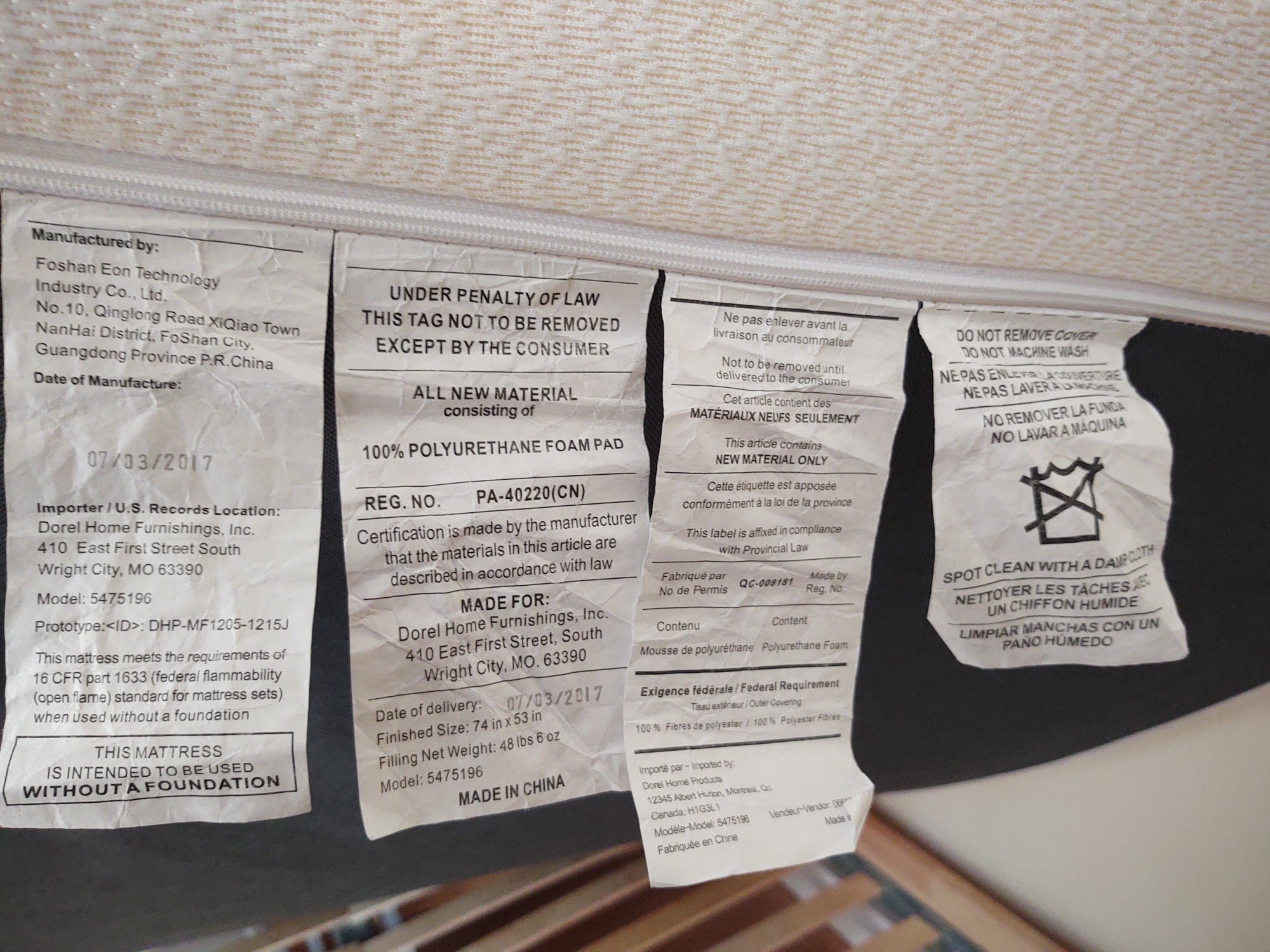
Read the law tag for "glass fiber" or "glass wool," treat "Do Not Remove Cover" as a clue, and require a written manufacturer disclosure plus finished-product certifications. No single logo proves "fiberglass-free" — you're stacking evidence.
Work through it in order:
- Read the sewn-in law tag. CDPH advises checking the label because fiberglass may be listed as "glass fiber". It can also appear as "glass wool."
- Know that absence isn't proof. There's no standardized disclosure requirement, so a tag that doesn't name fiberglass doesn't guarantee it's absent.
- Treat "Do Not Remove/Wash Cover" as a signal that the cover may be containing an internal barrier — a clue, not a verdict.
- Get it in writing. As the National Council on Aging advises, "If the tag or description is missing, contact the company directly for clarification before purchasing."
- Stack finished-product certifications — because each one covers a different thing.
| Certification | What it covers | Its limit |
|---|---|---|
| CertiPUR-US | Polyurethane foam content and emissions | Foam only — not the cover, barrier, or fiberglass status |
| GreenGuard Gold | Low chemical emissions / indoor air quality | Emissions, not "no fiberglass" |
| OEKO-TEX Standard 100 Class I | Restricted substances at the strictest baby/toddler tier, finished product | Substance limits, not a fiberglass test per se |
| GOTS | Organic textile inputs and prohibited chemical treatments | Only for organic cotton/wool components |
| MADE SAFE | Screens materials against a hazard list | Hazard screen, not a government non-toxic standard |
Here's the checklist met in practice: Nest & Wild states its beds are 100% fiberglass-free, built with CertiPUR-US foams, GreenGuard Gold glue, and OEKO-TEX-certified materials in Tupelo, Mississippi. When you want to compare builds that actually disclose all of this, you can see all fiberglass-free mattresses in one place rather than hunting through hangtags.
What happens if my child unzips or tears the mattress cover?
A torn or unzipped fiberglass cover can release glass fibers into the room, irritating skin, eyes, and airways — CDPH says never unzip a cover and to discard the mattress if the tear can't be repaired. A damaged cover turns a contained barrier into a cleanup problem.
The mechanism is physical release: opening or tearing the cover lets fine glass fibers migrate out of the mattress and onto surfaces and into the air. This matters more for kids, who spend more time in contact with the floor, the bedding, and the mattress surface. Poison Control's guidance is to follow the label and avoid unzipping a cover marked "do not remove."
Bottom line: a fiberglass-free build removes this entire scenario. There's no glass fiber to release when a curious kid works a zipper or a spill soaks through. If a leak has already happened, the next section covers cleanup.
How do I safely clean up fiberglass if a mattress has already leaked?
Isolate the room, shut off HVAC and fans, HEPA-vacuum and damp-wipe hard surfaces, never dry-sweep, launder soft items separately, and discard what can't be cleaned. Treat this as risk reduction, not guaranteed remediation.
The core CDPH-backed steps, in order:
- Keep children and pets out of the affected room.
- Turn off HVAC and fans and close doors so fibers don't spread to other rooms.
- Wear protection — disposable clothing, gloves, eye protection, and a well-fitting mask.
- HEPA-vacuum and damp-wipe hard surfaces. CDPH specifically says to use a HEPA vacuum and not to sweep, because sweeping spreads fibers into the air.
- Launder contaminated soft goods separately; if fibers can't be removed from fabric, throw the item out.
- Discard the mattress if the source can't be contained, and file a report with the CPSC incident reporting system.
If you're diagnosing whether your current bed is even the culprit, our companion guide on how to tell if a mattress has fiberglass walks through the label check and inspection steps. And if you're replacing the bed, the cleanest way to avoid a repeat is a build with no glass fiber to shed in the first place — you can read the full fiberglass-free hub before you shop.
Do bunk beds and guest-room mattresses need to be fiberglass-free too?
Yes — these beds see more handling, jumping, spills, and visitors unaware of cover warnings, so fiberglass-free is the lower-risk choice for high-misuse family settings. The exposure risk scales with how often a cover gets disturbed.
Bunk beds get jumped on, climbed over, and outgrown. Guest mattresses get inspected by visitors who've never seen the "Do Not Remove Cover" warning and may unzip it out of curiosity. Both settings raise the odds of the exact failure CDPH and Poison Control describe: cover opened, fibers released.
There's also a regulatory signal worth knowing. California enacted AB 1059, a statewide ban on new mattresses, juvenile products, and upholstered furniture containing textile fiberglass, effective January 1, 2027. Important honesty: that's a California rule only — it is not a national ban. But it tells you regulators view textile fiberglass as an avoidable consumer-exposure concern in family-use products.
For beds that take spills, jumping, and hand-me-down duty, durability matters as much as the barrier. Our fiberglass-free Luxury Hybrid is built for exactly that kind of hard family use — coil support that holds up to years of active kids and rotating guests, with the same CertiPUR-US, GreenGuard Gold, and OEKO-TEX certifications and no glass fiber inside.
Is a fiberglass-free mattress OK for a child with asthma or allergies?
It removes an airway irritant, which helps, but fiberglass is an irritant — not a classic allergen — so it's no substitute for dust-mite and moisture control. The bigger lever for an asthmatic child is the whole allergen plan, not the fire barrier alone.
A 2022 peer-reviewed review describes fiberglass as a respiratory, skin, and eye irritant and asthmagen, with children flagged as a special risk group because they spend more time in close contact with the bed. Removing it removes a potential trigger — genuinely worthwhile for a sensitive kid.
But it works alongside allergen control, not instead of it. The 2020 U.S. asthma guideline update gives a conditional recommendation for impermeable mattress covers only as part of a multicomponent allergen-mitigation strategy — not as a standalone fix. The CDC lists allergen-proof encasements plus washing bedding in hot water every 1–2 weeks as first-line dust-mite control.
One more reason to prioritize verified low-emission materials: the EPA notes flame-retardant chemicals can escape into air and attach to dust, with children more exposed through floor contact and hand-to-mouth behavior. A waterproof mattress protector fits into a dust-mite plan as the washable, encasing layer between the child and the bed.
How long should a kids' fiberglass-free mattress last before replacement?
Fiberglass-free doesn't extend lifespan — replace when it sags, loses support, or tears, using durability and body alignment as the real signals. The fire barrier has nothing to do with service life.
The performance factors that actually predict replacement come from mattress durability testing. ASTM F1566 evaluates firmness retention, durability, effect of impact, and height change — those are the signals that matter, not whether the bed contains glass fiber. Some manufacturers run a 100,000-cycle rollator test to simulate roughly 10 years of use, but that's one company's product-testing method, not a universal lifespan rule.
Practical replace-triggers for a kid's bed:
- Visible sagging or a body impression that doesn't recover
- Loss of support — the child no longer stays comfortably aligned
- Any tear or worn spot in the cover (which matters even more if a barrier is inside)
- The mattress no longer fits the child's size or weight as they grow
The through-line: a durable, intact cover is what keeps any barrier contained. If you're weighing a foam versus a coil build for how hard your kids sleep, our Original Foam vs Luxury Hybrid comparison lays out the durability trade-offs side by side.
Frequently asked questions
Does an American-made mattress guarantee it's free of fiberglass?
No. "Made in USA" only tells you where the mattress was assembled — not what fire barrier is inside. Because U.S. law is a performance standard, a domestic maker can still use fiberglass. Verify with the law tag, the product specs, or a written manufacturer statement; American manufacturing alone is not proof of a fiberglass-free build.
Which single certification proves a mattress is fiberglass-free?
None does directly. "Fiberglass-free" is a manufacturer claim, not a certification. Certifications like OEKO-TEX Standard 100 Class I and GreenGuard Gold support a safer, low-emission build, but you confirm the absence of fiberglass through the brand's written disclosure of its finished-product materials — not by a single logo.
Can a kids' mattress pass fire-safety standards without fiberglass?
Yes. The federal open-flame rule (16 CFR Part 1633) is a performance standard that limits the fire a mattress generates, not a materials mandate. Brands can comply using wool, silica/rayon, modacrylic, or treated fibers instead of glass fiber, so a fiberglass-free kids' mattress can be fully fire-compliant.
Does the California fiberglass ban apply nationwide?
No. California's AB 1059 bans new mattresses and juvenile products containing textile fiberglass starting January 1, 2027, but it's a state-only rule. It doesn't apply nationally. It's still a useful signal that regulators treat textile fiberglass as an avoidable consumer-exposure concern in family products.
Is "CertiPUR-US" enough to know a mattress is non-toxic?
No. CertiPUR-US certifies only the polyurethane foam's content and emissions — it says nothing about the cover, the fire barrier, or whether fiberglass is present. For a fuller picture, stack it with a finished-product certification such as GreenGuard Gold or OEKO-TEX Standard 100 Class I, plus the brand's written fiberglass disclosure.

The bottom line: who should prioritize fiberglass-free, and who doesn't need to
Prioritize it if your child may unzip, spill on, jump on, or outgrow the bed, or for guest and bunk use — those are the exact conditions where a barrier gets exposed and the contamination risk becomes real. Skip the urgency if an intact-cover mattress stays undisturbed by an adult, where the fibers stay sealed.
Either way, ask the better question: which fire barrier, how is it contained, and how do I verify it? A disclosed, certified, fiberglass-free build answers all three. When you're ready to compare beds that actually publish their materials, see all fiberglass-free mattresses — 100% fiberglass-free, CertiPUR-US, GreenGuard Gold, and OEKO-TEX certified, built in Tupelo, Mississippi.