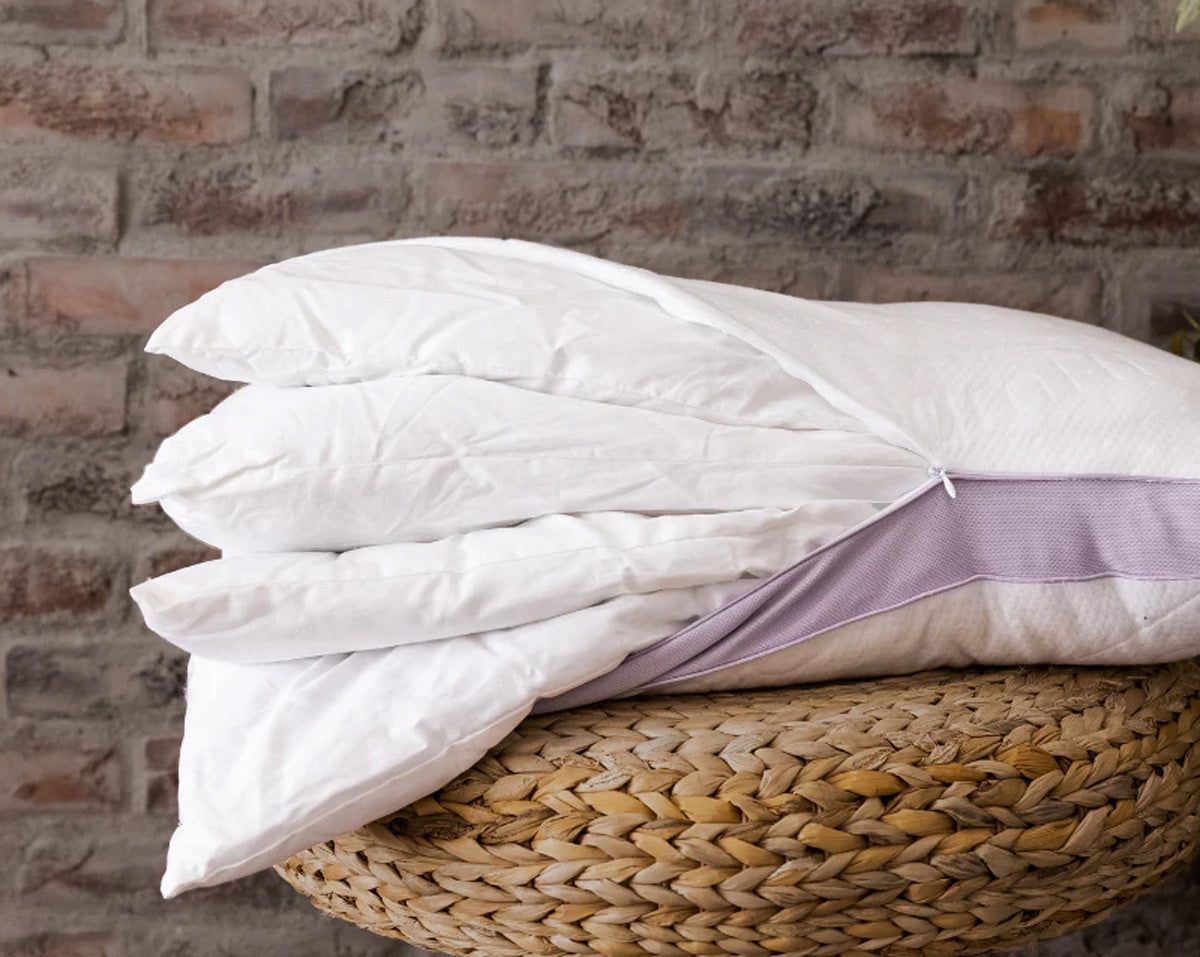


If a mattress has no fiberglass, how can it be fire-safe? Here's the short answer: U.S. mattress law is a performance standard, not a material rule. A bed passes by slowing how fast it releases heat—not by hiding fiberglass inside. Federal rules cap peak heat release at 200 kW and total heat release at 15 MJ in the first 10 minutes of a 30-minute open-flame test (CPSC). Fiberglass was never required to hit those limits.
Key takeaways
- No mattress is literally "fireproof"—federal law requires it to be fire-safe, meaning it slows a fire enough to stay under set heat-release limits.
- 16 CFR Part 1633 is a performance standard: it caps heat release (200 kW peak; 15 MJ in the first 10 minutes) but never names a required barrier material.
- Wool, rayon/viscose, modacrylic, and silica-based barriers all replace fiberglass and can pass the same federal test.
- Fiberglass is mainly a hazard when a cover is opened or torn—one 2022 study found up to 1% migrated to adjacent layers.
- "Non-toxic" and "Made in USA" don't prove a mattress is fiberglass-free—check the law tag and ask for a written materials list.
Can a mattress really be fire-safe without any fiberglass?
Yes. U.S. mattress law is a performance standard, not a material rule—a mattress passes by slowing heat release, not by containing fiberglass. To comply with the federal open-flame rule (16 CFR Part 1633), a mattress set must keep peak heat release at or below 200 kW at any point during the 30-minute test and total heat release at or below 15 MJ in the first 10 minutes, per the Consumer Product Safety Commission (CPSC).
First, a language fix that clears up most of the fear: "fireproof" is the word shoppers search, but no mattress is fireproof. The legal goal is fire-safe—slowing a fire's growth so people have time to escape. Every U.S. mattress must meet two federal standards: 16 CFR 1632 for cigarette smolder and 16 CFR 1633 for open flame, both enforced under the Flammable Fabrics Act.
Bottom line: Fiberglass was never legally required. A barrier engineered to pass the heat-release test protects you just as well—which is exactly how a properly built fiberglass-free bed like the American-made, fiberglass-free Original Mattress is constructed. For the full picture, see our fiberglass-free mattress hub.

What is a mattress flame barrier, exactly?
A mattress flame barrier is a fire-resistant layer built into or just beneath the cover that chars and insulates to slow heat release during a fire. It sits between the foam or fiber fill and the outer ticking, and its job is to delay ignition long enough for the finished mattress to stay under federal limits.
A peer-reviewed materials study describes these barrier fabrics as layers placed between polyurethane foam or fiber fill and the outer cover, and notes the commercial barriers tested were chosen because they were inherently flame-resistant—no halogenated or organophosphorus flame retardants added (Polymer Testing, Vassiliou et al., 2021).
One detail matters more than any other: the open-flame test evaluates the whole assembled product—foam, springs, glue, ticking, and barrier together—not a fabric swatch. Compliance is a system property, not a single ingredient. That's why the barrier alone doesn't tell the whole story, and why "what fiber is inside?" is only part of the right question.
How do fiberglass-free mattresses pass the federal open-flame fire test without it?
They use a non-fiberglass barrier that keeps peak heat release at or below 200 kW and total heat release under 15 MJ in the first 10 minutes—the exact thresholds set by federal law, which never names a required material.
The test itself is specific. A twin-size specimen is exposed to two T-shaped propane burners: one on the top surface for 70 seconds and one on the side for 50 seconds, simulating burning bedclothes (CPSC standard overview). The mattress is then watched for 30 minutes. It fails if peak heat release ever exceeds 200 kW, or if total heat release tops 15 MJ in the first 10 minutes.
"The regulation is a performance standard, not a design standard; it does not specify the use of individual components, such as FR foams, barriers or thread, to meet the standard." — U.S. Consumer Product Safety Commission, mattress flammability Q&A
That single sentence is the whole answer to the objection. Any construction that chars and insulates enough to pass qualifies—wool, rayon/viscose, modacrylic, silica, or engineered blends. CPSC materials add that the goal of 1633 is to "minimize or delay flashover" when a mattress ignites in a typical bedroom fire (CPSC rulemaking record).
Bottom line: Fiberglass-free is a construction choice, not a safety compromise—when the bed is engineered and tested to pass. That's the approach behind the certified, fiberglass-free Original Mattress: a compliant barrier system built without the material shoppers are trying to avoid.

What materials replace fiberglass as a flame barrier, and are they safe to sleep on?
Wool, rayon/viscose, modacrylic, and silica-based barriers all replace fiberglass; safety depends on containment and certification, not the material name alone. CPSC lists cotton, rayon, polyester, melamine, modacrylic, fiberglass, and aramid (Kevlar)—or combinations—among barrier materials used to meet the standard (CPSC barrier materials guidance).
| Barrier material | How it resists fire | Containment/exposure risk | Feel & breathability | Trade-off note |
|---|---|---|---|---|
| Wool | Naturally hard to ignite; chars and self-extinguishes due to keratin and moisture content | Low—natural fiber, no glass fragments to shed | Breathable, temperature-regulating | Higher material cost; sourcing/loft varies by maker |
| Rayon/viscose (barrier sock) | Engineered barrier knit that chars and insulates | Low when intact and enclosed | Thin, flexible, generally breathable | Often blended—verify the full barrier chemistry |
| Modacrylic | Inherently flame-resistant synthetic fiber that self-extinguishes | Low when enclosed | Soft, often blended into batting | Synthetic; "fiberglass-free" ≠ "chemical-free" |
| Silica-based | Silica-infused fibers that resist high heat without burning | Low when intact and enclosed | Firm barrier feel; usually hidden under comfort layers | Less breathable on its own; depends on construction |
| Fiberglass | Glass fibers melt/char and physically block flame spread | Higher—can escape and irritate if cover is opened or torn | Hidden layer; not a comfort factor | Least expensive option; the exposure hazard is the whole controversy |
Honest note: "Fiberglass-free" tells you what's not inside, not that a bed is automatically "chemical-free." The right move is to verify the actual barrier and look for real certifications—more on that below.
Is fiberglass actually dangerous, or only a problem when the cover is opened?
Fiberglass is mainly a hazard when the cover is opened or torn—intact and enclosed, exposure risk is far lower, but the containment failure mode is real. A 2022 peer-reviewed study of mattress covers found that in two covers, over 50% of the inner sock layer was fiberglass, up to 1% migrated to adjacent fabric layers, and the fragments measured about 30–50 µm in aerodynamic diameter (Feldman et al., 2022; full text at PMC).
The California Department of Public Health is blunt about the failure mode: keep the outer cover sealed shut and never unzip it, because contact with fiberglass can irritate the eyes and skin, and inhaled fragments can irritate the nose, throat, and lungs (CDPH factsheet).
Here's the balanced view most articles skip: CPSC states that the continuous-filament fiberglass used in textiles and flame-retardant barriers is not considered hazardous and is too large to be inhaled deeply (CPSC risk assessment). So intact, the risk is low. The problem is that covers get unzipped by mistake, torn by moves, or opened out of curiosity.
The smart buyer question isn't just "does it contain fiberglass?" It's "what is the barrier, how is it enclosed, and what happens if the cover is removed?" A fiberglass-free bed sidesteps the worst-case cleanup entirely.
Why did mattress makers start using fiberglass in the first place?
Fiberglass became common because it's the least expensive way to pass the open-flame test—not because the law ever required it. Since 1633 is performance-based, manufacturers were free to pick any compliant barrier, and fiberglass fit the role as a low-cost insulating layer.
The National Poison Control Center summarizes the mechanism plainly: fiberglass can be incorporated as a flame-retardant agent and acts as thermal insulation during a fire (Poison Control). As one consumer teardown guide put it, "mattress companies use fiberglass within their mattress because it is an inexpensive method to achieve required fire resistance ratings" (NapLab).
The market is now moving away from it. California's AB 1059 bans textile fiberglass in mattresses effective January 1, 2027, according to the CDPH factsheet. That's a state rule—federal law still permits fiberglass nationwide—but it signals where regulators see the risk.
Does a "non-toxic" or "Made in USA" label mean a mattress is fiberglass-free?
No. Neither label proves fiberglass is absent—there's no standardized federal fiberglass disclosure, so labels alone are not proof. "Non-toxic" and "natural" are material or marketing claims that don't identify the fire barrier, and "Made in USA" only tells you where the bed was assembled.
CPSC is clear that the rule doesn't specify components and lists fiberglass among accepted barriers regardless of country of origin (CPSC Q&A). A U.S.-made bed can still use fiberglass; a foreign-made one can be fiberglass-free. Assembly location and barrier choice are two separate facts.
This is where a specific, verifiable brand fact matters more than a slogan. Nest & Wild is built in Tupelo, Mississippi and is 100% fiberglass-free, with CertiPUR-US foams, GreenGuard Gold glue, and OEKO-TEX-certified materials. The geography is real and named—but it's the fiberglass-free construction and the certifications that answer the safety question, not the "Made in USA" line by itself. You can read the full construction story on our fiberglass-free mattress hub.
How can I verify a mattress is fiberglass-free before I buy, without cutting it open?
Read the law tag for glass-fiber terms, ask for a written materials list, and look for real certifications—never treat marketing labels as proof. Here's the framework, in order of reliability:
- Read the sewn-in law tag. Look for "glass fiber," "glass wool," or "fiberglass." CDPH notes fiberglass may be listed as "glass fiber" on a mattress label (CDPH).
- Treat "Do Not Remove Cover" as a flag, not proof. That warning can mean the cover is part of the fire barrier system—but it doesn't identify the material by itself.
- Ask the seller for a written materials list. Absence of a fiberglass mention is not the same as absence of fiberglass—there's no standardized federal disclosure requirement, so a listing that avoids the word proves nothing.
- Look for verifiable certifications. CertiPUR-US, GreenGuard Gold, and OEKO-TEX are third-party programs you can confirm—stronger than any "natural" claim.
If you want a deeper walk-through of law tags and warning signs, our sibling guide on how to tell if your mattress has fiberglass covers the inspection step by step (link once that spoke is live). The one-line rule: written confirmation plus a clean law tag beats marketing copy every time.
Which fiberglass-free barrier holds up best for kids' rooms, heavier sleepers, or active households?
No barrier is proven "best" long-term, but a fully enclosed, integrated barrier resists the abrasion and cover-handling that cause exposure over years. There's an honest evidence gap here: no primary head-to-head aging study compares wool, silica/rayon, and blends under years of compression, laundering, or cover removal.
What is defensible comes straight from how the law works. Because 16 CFR 1633 tests the finished mattress as a system, durability is best judged at the whole-product level, and the smartest choice is the barrier least likely to be disturbed—fully enclosed and integrated, not a thin standalone layer (CPSC, system-level test basis). NIST's review of barrier methods reinforces that real performance depends on tested fire behavior, not the fiber's name alone (NIST Technical Note).
For a nursery where covers get washed, going fiberglass-free lowers the accidental-release risk if a cover is ever opened or damaged—but you still want a bed independently certified to meet fire standards through another barrier system.
For side sleepers, heavier sleepers, and anyone who wants more support and edge stability in a fiberglass-free build, the fiberglass-free Luxury Hybrid pairs a supportive coil system with the same certified, no-fiberglass construction as the all-foam Original.
The bottom line: fiberglass-free is a construction choice, not a safety compromise
A well-built fiberglass-free mattress meets the same federal open-flame limits as any other bed—and skips the exposure risk fiberglass creates. The law is a performance standard, fiberglass was never required, and a barrier engineered to pass keeps you just as protected without the containment hazard.
If you've read this far, you now know exactly what to look for: a clean law tag, a written materials list, and real certifications. Nest & Wild already meets that checklist—100% fiberglass-free, CertiPUR-US + GreenGuard Gold + OEKO-TEX certified, and built in Tupelo, Mississippi. When you're ready, shop the Original Mattress or see all fiberglass-free mattresses to compare the Original and the Luxury Hybrid side by side. Still deciding on type or firmness? Our guide on how to buy a mattress without regret walks through the rest.
Frequently asked questions
Is a flame barrier required by law, or can I buy a mattress without one?
A flame barrier is effectively required for any mattress sold in the U.S. residential market, because federal law mandates compliance with both 16 CFR 1632 (cigarette smolder) and 16 CFR 1633 (open flame), per CPSC. The law doesn't require a specific material or method, so a bed can pass with a sewn-in barrier or inherently flame-resistant construction—but it can't legally be sold without meeting the standards.

What actually happens if I unzip or remove the cover on a mattress that contains fiberglass?
Unzipping a cover on a mattress that uses fiberglass as its barrier can release tiny glass fragments into the room, spreading onto soft surfaces and potentially irritating eyes, skin, nose, throat, and lungs. The California Department of Public Health advises keeping the cover sealed and never unzipping it (CDPH). It's a physical release of fibers, not a chemical leak—and cleanup can be extensive.
Do fiberglass-free mattresses cost more, and is the difference worth it?
Fiberglass-free beds often cost more, but the premium isn't uniform—it's driven by the barrier material and overall mattress tier, not fiberglass-free status alone. Fiberglass is the least expensive barrier, so alternatives like wool, modacrylic, or silica generally add cost. Whether that's worth it depends on how much you value avoiding the exposure hazard versus paying for a higher-end build.
Are chemical flame retardants used instead of fiberglass, and are those any better?
Some mattresses use chemical flame retardants instead of fiberglass, but that doesn't automatically make them healthier. CPSC has assessed several FR-treatment materials as not expected to pose appreciable health risk to sleepers (CPSC risk assessment). Health risk depends on the specific chemistry, encapsulation, and cover integrity—not simply "chemical versus fiberglass." Certified, inherently flame-resistant barriers avoid added FR chemicals altogether.
How do I clean a fiberglass-free mattress without damaging the flame barrier?
Follow the maker's care instructions: spot clean with a damp cloth and mild detergent, blot with water, and dry thoroughly without heat—avoid bleach, soaking, machine washing, and machine drying, which can damage the cover or barrier. Don't unzip, scrub, or heat-dry unless the manufacturer explicitly says the cover and barrier are washable. Gentle, minimal surface cleaning protects both the fabric and the barrier system.