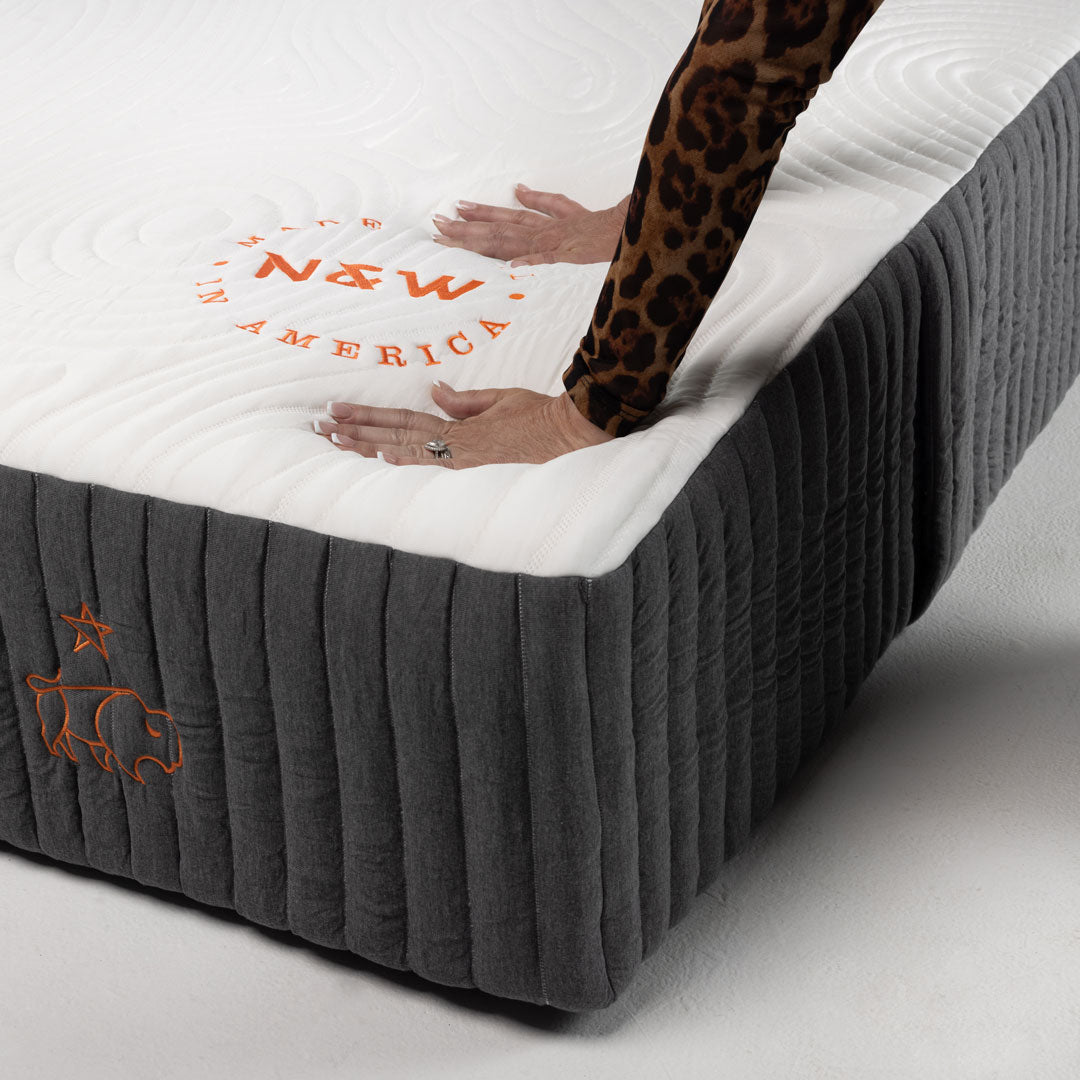


A fiberglass-free mattress uses no fine glass fibers as its fire barrier, relying instead on materials like wool, rayon, or silica-based blends to meet federal flammability rules. That matters because when the outer cover of a fiberglass-containing bed is opened or torn, fibers can escape and irritate skin, eyes, and airways — a peer-reviewed 2022 analysis in PMC of four mattress covers found fiberglass in two of them, with inner sock layers over 50% fiberglass and up to 1% migrating into adjacent fabric.
Choosing fiberglass-free is less about "safe vs. unsafe" and more about knowing what fire barrier a brand uses and how clearly it discloses it. Nest & Wild builds 100% fiberglass-free mattresses in Tupelo, Mississippi, using CertiPUR-US foams, GreenGuard Gold glue, and OEKO-TEX certification.
Key takeaways
- Fiberglass-free means the mattress does not use glass fibers as its fire barrier — it does not automatically mean "non-toxic" or "organic."
- Every U.S. mattress must pass the same federal flammability standard (16 CFR Part 1633); fiberglass is one cheap way to pass it, not a requirement.
- Sealed inside an intact mattress, fiberglass is low-risk; the hazard appears when the cover is opened or damaged.
- No certification alone proves a mattress is fiberglass-free — CertiPUR-US is the closest, but it covers only the foam.
- The surest verification is a written, model-specific statement from the maker naming the fire barrier and confirming no fiberglass.
What is a fiberglass-free mattress, and why do so many mattresses contain fiberglass?
A fiberglass-free mattress uses no fine glass fibers in its fire barrier, meeting flammability rules with materials like wool, rayon, or silica-based socks instead. Fiberglass itself is a synthetic material made of extremely fine glass fibers, and manufacturers reach for it because it is an inexpensive way to pass the federal test.
Every general-use mattress sold in the U.S. must carry a General Certificate of Conformity showing it meets the flammability standard 16 CFR Part 1633, per the U.S. Consumer Product Safety Commission. That rule is performance-based: it caps how fast and how hot a mattress can burn — no more than 200 kW peak heat release and 15 MJ total in the first 10 minutes, according to Avocado's summary of the federal standard — but it never names a specific barrier material. Fiberglass simply happens to be the cheapest way to hit those numbers.
For a health-conscious buyer, that's the whole point: the safety question isn't whether a bed passed the test — they all did — but how it passed. If a hidden glass-fiber layer sounds like something you'd rather not sleep on, it helps to start with a maker that names its build. You can see all fiberglass-free mattresses Nest & Wild makes in Tupelo, Mississippi.

Is fiberglass in a mattress actually dangerous, or just an irritant?
Sealed inside an intact mattress, fiberglass poses low risk; danger comes when the cover is opened or damaged and fibers escape into the air, causing skin, eye, and airway irritation.
Treat mattress fiberglass as a containment problem, not a hidden poison. A CDC/ATSDR toxicology fact sheet on synthetic vitreous fibers reports that short-term exposure causes reversible irritation of the skin, eyes, nose, throat, and lungs, and that animal studies show repeated high exposure can produce lung inflammation and fibrosis. On the bigger fear — cancer — a CDC criteria document concluded that available occupational data did not show cancer linked to fibrous glass exposure.
In two of four mattress covers tested, inner sock layers were over 50% fiberglass, and up to 1% of the fiberglass migrated into adjacent fabric — a potential consumer exposure risk if the outer zipper cover is opened (Hohenstein et al., 2022).
The Environmental Working Group makes the same practical point: if a cover is removed or damaged, fragments can escape into the air and create an inhalation hazard plus skin and eye irritation. Bottom line: intact means low risk; broken or opened means exposure risk — which is exactly why disclosure and construction matter more than alarm.
Isn't fiberglass-free the same as non-toxic?
No. Fiberglass-free is a specific construction claim about the fire barrier; non-toxic is a broader, unregulated marketing term that guarantees neither the absence of fiberglass nor any defined chemical standard.
A non-toxic mattress is an unregulated marketing phrase generally implying low or absent levels of certain chemicals — but it does not confirm whether fiberglass is present. The two claims answer different questions. A mattress can be fiberglass-free and still contain foams or adhesives whose chemistry you'd want to check. And a mattress can be marketed "non-toxic" while a glass-fiber sock still sits under the cover.
The reliable move is to ignore the umbrella words and check three concrete things: the named fire barrier, the full materials list, and third-party certifications. As the EWG's reporting on hidden mattress hazards underscores, vague phrasing like "proprietary fire barrier" tells you nothing verifiable. If a brand won't name what's between you and the flame test, treat the "non-toxic" label as decoration.

Which certifications actually prove a mattress is fiberglass-free?
None alone prove it. CertiPUR-US is the closest but covers only the foam; OEKO-TEX, GOTS/GOLS, and GREENGUARD Gold certify other things — chemical emissions, organic content, indoor air — not fiberglass absence.
This is where most buyers get misled by a logo. CertiPUR-US states its certified foam is made without fiberglass and must have low VOC emissions under 0.5 ppm, with no formaldehyde, no regulated phthalates, and no mercury, lead, or other heavy metals — but that certification applies only to the flexible foam, not the cover or fire sock where fiberglass usually lives. Consumer guidance from the National Council on Aging says plainly that OEKO-TEX, GOTS, GREENGUARD Gold, and CertiPUR-US do not guarantee a mattress is fiberglass-free.
"CertiPUR-US and OEKO-TEX Standard 100 ensure foams are free from harmful substances, but they don't guarantee no fiberglass." — MattressVetted
| Certification | What it covers | What it does NOT prove | Relevance to fiberglass |
|---|---|---|---|
| CertiPUR-US | Flexible polyurethane foam: low VOC (<0.5 ppm), no formaldehyde, phthalates, or heavy metals | Nothing about the cover, fire sock, or barrier layer | Closest signal — certified foam is made without fiberglass, but foam only |
| OEKO-TEX | Textile chemical safety (tested for harmful substances) | Whether the fire barrier contains fiberglass | Reassures on textile chemistry, not fiberglass absence |
| GOTS / GOLS | Organic fiber (GOTS) and organic latex (GOLS) content | Fiberglass presence anywhere in the build | Confirms organic sourcing, not a fiberglass-free barrier |
| GREENGUARD Gold | Low chemical emissions and indoor air quality | Whether a glass-fiber layer is present | Supports a "lower-emitting" claim, not fiberglass-free status |
Certifications are a real signal — Nest & Wild carries CertiPUR-US foams, GreenGuard Gold glue, and OEKO-TEX certification — but they earn their weight only when paired with a written no-fiberglass disclosure that covers the whole build, not just the foam.
What do fiberglass-free mattresses use instead — and are those materials safer?
They use wool, rayon or silica socks, cotton, PLA batting, or modacrylic to pass flammability rules. These avoid fiberglass exposure, but they aren't automatically "safer" overall — that depends on the full build.
Because 16 CFR Part 1633 is performance-based, any of these can pass, as Avocado's help center notes — the standard can be met with wool, rayon, PLA, modacrylic, chemical flame retardants, or fiberglass. Here's how the common non-fiberglass barriers compare:
- Wool — a natural barrier that chars rather than melts, which is why organic-style beds favor it. A material-property advantage, not a guarantee the whole mattress is cleaner.
- Rayon/silica socks — meet flammability rules without glass fibers, but "silica" wording on a tag confuses buyers, so verify what it actually means.
- Cotton — breathable and familiar, often paired with another barrier.
- PLA batting (polylactic acid) — plant-derived but still an engineered fiber.
- Modacrylic — a synthetic inherently flame-resistant fiber; effective, though not "natural."
The honest caveat: fiberglass-free is not the same as non-toxic. Safety depends on adhesives, foams, and any chemical treatments used to pass the fire test — which is why a full materials list beats a single reassuring word. A dedicated guide on what makes a mattress fireproof without fiberglass will break down each flame barrier in more depth as that resource publishes.
How can I tell if a mattress has fiberglass?
Check the law tag for "glass fiber," "glass wool," or "silica," treat a "do not remove cover" warning as a red flag, and get written confirmation from the maker. Here's the workflow:
- Read the law tag and care label. Look for material terms like fiberglass, glass fiber, or glass wool. Per the California Department of Public Health, fiberglass may be labeled as "glass fiber" — so the exact word "fiberglass" being absent proves nothing.
- Note "do not remove cover" language. A zippered cover paired with "do not remove" or "do not wash" often signals a fire barrier underneath. It's an inference clue, not proof.
- Understand the flashlight test's limit. A low-angle light can reveal reflective fibers only if fiberglass has already escaped through a rip or worn seam. It cannot reliably rule fiberglass in or out on an intact bed.
- Ask for written confirmation. If the label is vague, contact the maker and request confirmation in writing covering the cover, the fire sock, and any flame-retardant layer.
A forthcoming Nest & Wild guide on how to tell if your mattress has fiberglass — and what to do about it — will walk through inspection and cleanup step by step once it's live.
Are fiberglass-free mattresses good for back pain, and do they sleep cool?
Yes — support, firmness, and cooling come from construction (coils, foam density, latex, breathable covers), not from whether a mattress contains fiberglass. Choose by your body and sleep style, then confirm it's fiberglass-free.
Fiberglass status is a fire-barrier choice; it has nothing to do with how a bed cradles your spine. Support and pressure relief come from the core — coil gauge and count, foam density, latex, zoning — as reflected in NCOA's review guidance, which flags supportive hybrid builds among fiberglass-free models. Match construction to need:
- Back pain and side sleepers: prioritize a robust support core with contouring comfort layers. Support-seekers do well on a hybrid; pairing it with an adjustable bed base lets back-pain sleepers offload pressure with zero-gravity positioning.
- Hot sleepers: lean toward coil-heavy hybrids, latex, and breathable covers rather than dense memory foam, which traps more heat. Breathable bedding such as the Nest & Wild bamboo sheet set compounds the cooling effect.
If you sleep hot or wake up sore, that's a construction problem you solve with airflow and support — not something you fix by chasing the fiberglass label alone. This is product-selection guidance, not medical advice; if back pain is persistent, talk to a clinician.
How much do fiberglass-free mattresses cost, and is the premium worth it?
Fiberglass-free queens run roughly $899–$2,712; the price reflects materials, certifications, and features — not fiberglass removal by itself. Whether it's worth it depends on how much you value transparency and lower exposure risk.
The clearest market snapshot comes from NCOA's guide, which puts fiberglass-free queens between $899 and $2,712 before discounts — spanning mid-range to premium. And fiberglass-free is now the norm, not the exception: a NapLab analysis of 410 mattresses found 89.5% (367) confirmed fiberglass-free and only 7.8% (32) confirmed to contain it. The premium, where it exists, comes from upgraded foams, disclosed barriers, and third-party certifications — the same things that raise cost independent of the fire barrier.
Who this is NOT for: if your goal is a sub-$400 marketplace mattress, a certified, disclosed, American-made build isn't your match — those bargain listings are exactly where undisclosed glass-fiber socks tend to show up, and where the peer-reviewed exposure findings above are most relevant. For buyers who want transparent materials, lower exposure risk, and easier cleanup if a cover is ever damaged, the premium is defensible.
What should you check before buying — and what should you ask the manufacturer?
Get the exact fire barrier named in writing, read the law tag, and confirm no fiberglass in the cover, fire sock, and any flame-retardant layer. Vagueness or refusal to disclose is your signal to keep looking.
Use this manufacturer-confirmation checklist before you buy:
- Ask for the exact fire barrier material by name for the exact model — brands may use "glass fiber," "glass wool," or "silica" instead of "fiberglass."
- Request written confirmation that the mattress contains no fiberglass anywhere — cover, inner fire sock, and any flame-retardant layer — so you keep the record.
- Verify the law tag and full spec sheet against what the brand told you.
- Treat red flags as disqualifiers: vague "fire sock" language, a bare "do not remove cover" warning with no material named, or any refusal to disclose.
The regulatory ground is shifting, too: California signed a statewide ban on the sale of mattresses and upholstered furniture containing fiberglass in October 2023, effective January 1, 2027, per the California Department of Public Health. For a kid's room or guest bed — where a mattress gets jumped on, spilled on, and eventually worn through — full material transparency and a named non-fiberglass barrier matter most; a dedicated guide on whether a fiberglass-free mattress is worth it for families with kids will go deeper once it publishes.
The surest buy is a brand that discloses no fiberglass in writing and names its build. That's the standard Nest & Wild is built to — 100% fiberglass-free, made in Tupelo, Mississippi, with CertiPUR-US foams, GreenGuard Gold glue, and OEKO-TEX certification. You can see all fiberglass-free mattresses and read the disclosed materials for yourself.

Fiberglass-Free Mattress FAQ
Does an organic or all-natural mattress automatically mean it's fiberglass-free?
No. "Organic" and "all-natural" usually describe the source of comfort materials like cotton, wool, or latex — not the fire barrier. A mattress can carry natural comfort layers and still use a glass-fiber barrier unless the brand explicitly names a non-fiberglass alternative. Verify the materials list, law tag, and a written disclosure rather than trusting the category label.
Can I clean fiberglass out of a mattress myself, or should I get rid of it?
Containment comes first, and disposal is often the safer choice. The California Department of Public Health advises covering or wrapping the mattress before removal, wet-wiping hard surfaces instead of dry dusting, using a sealed HEPA vacuum, washing contaminated fabrics separately, and discarding the mattress if fibers keep spreading. A visibly leaking mattress is usually best removed from use rather than "cleaned."
Are American-made mattresses more likely to be fiberglass-free than imported ones?
No — fiberglass status is a brand-level construction choice, not a function of country of origin. Both U.S.-made and imported mattresses can be fiberglass-free or not. The decisive check is the brand's disclosure: whether it names the fire barrier and explicitly avoids fiberglass, glass fiber, or glass wool, regardless of where the mattress was built.
What is a General Certificate of Conformity, and does it prove a mattress is fiberglass-free?
A General Certificate of Conformity is documentation the U.S. Consumer Product Safety Commission requires, certifying that a general-use mattress meets federal flammability standards (16 CFR parts 1632 and/or 1633) based on testing. It proves the mattress passed the fire test — it does not identify the barrier material or prove the mattress is fiberglass-free.
If the word "fiberglass" isn't on the tag, does that mean the mattress doesn't have it?
No. Fiberglass can appear on labels as "glass fiber" or "glass wool," and some tags don't clearly disclose the barrier at all. An absent word is not proof of absence. Get written, model-specific confirmation from the manufacturer covering the cover, fire sock, and any flame-retardant layer before you rely on it.
The health and safety information here is drawn from public-health and standards sources and is general education, not medical advice. For personal health concerns about exposure, consult a qualified professional.