

CertiPUR-US certifies that the flexible polyurethane foam inside a mattress meets strict limits on harmful chemicals and emissions — but only the foam, not the whole mattress. It says nothing about the adhesives, the flame barrier, the cover, or whether the bed contains fiberglass. According to the Alliance for Flexible Polyurethane Foam, the mark "certifies flexible polyurethane foam only, not the finished mattress." So the real buying question isn't "does it have the logo?" — it's "how many layers are actually certified?"
Key takeaways
- CertiPUR-US certifies only the polyurethane foam core — its content, emissions, and durability — not the finished mattress.
- Certified foam must be made without formaldehyde, ozone depleters, regulated phthalates, mercury, lead and other heavy metals, and PBDE/TDCPP/TCEP flame retardants, with VOC emissions under 0.5 ppm.
- It does not cover adhesives, flame barriers, antimicrobial finishes, latex, the cover — or fiberglass.
- OEKO-TEX certifies textiles like the cover; GreenGuard Gold certifies whole-product low emissions including glue. Stacking certifications closes the gaps.
- CertiPUR-US is a material/emissions standard, not proof a mattress is "chemical-free" or medically safer.
What does CertiPUR-US certification actually mean for my mattress?
It's a real, valuable baseline — a verified statement about the foam — but not a whole-mattress guarantee. The program tests the foam, not the bed you sleep on.
That distinction matters because a mattress is a stack of materials: foam layers, the glue holding them together, a flame barrier, antimicrobial finishes in some beds, and the cover. The CertiPUR-US logo speaks only to the foam in that stack. As the Alliance for Flexible Polyurethane Foam puts it, the program "provides a verified baseline that the foam itself meets defined chemical criteria... not to the finished product as it arrives in your home."
If you're shopping for a genuinely non-toxic, fiberglass-free mattress, that reframe is the whole game. Stop hunting for one logo and start counting how many layers of the mattress carry independent certification. This guide walks through exactly what CertiPUR-US covers, what it skips, and how to read the gaps before you buy.

What is CertiPUR-US, exactly, and who runs it?
CertiPUR-US is a voluntary foam certification program run by the nonprofit Alliance for Flexible Polyurethane Foam, started in 2008 to combat substandard imported foams. It is not a government regulation — no law requires a mattress to carry it.
The program exists for a specific reason. Per the official "What is Certified Foam?" page, "CertiPUR-US-certified foams meet standards for content, emissions and durability, and are analyzed by independent, accredited laboratories. The program was established in 2008 to combat substandard foams imported from other countries that contained substances banned in the U.S. or listed by chemical watch groups as potentially harmful."
Three things to remember:
- It's voluntary. A mattress without the logo isn't automatically unsafe — and one with it isn't automatically certified end-to-end.
- It tests three things: chemical content, VOC emissions, and durability.
- It's foam-only. The scope was built around polyurethane foam, which is why so much of a mattress falls outside it.
That credibility is real — and it's also exactly why the gaps below catch so many shoppers off guard. A trustworthy certification with a narrow scope is easy to mistake for a broad guarantee.
What chemicals does CertiPUR-US certified foam exclude?
Certified foam must be made without formaldehyde, ozone depleters, regulated phthalates, mercury, lead and other heavy metals, and PBDE, TDCPP, and TCEP flame retardants — with VOC emissions under 0.5 parts per million. That excluded list is the heart of the certification.
The CertiPUR-US Official FAQ spells it out: certified foam is "Made without formaldehyde, Made without ozone depleters, Made without phthalates regulated by the U.S. Consumer Product Safety Commission, Made without mercury, lead and other heavy metals, Low VOC emissions for indoor air quality (less than 0.5 parts per million), Screened for relevant chemicals, including flame retardants, that are classified as carcinogens, mutagens or reproductive toxins."
Here's what each exclusion targets, in plain English:
- Formaldehyde — a known irritant and carcinogen sometimes off-gassed by cheaper foams.
- Ozone depleters (CFCs) — older blowing agents used to make foam, restricted for environmental harm.
- Regulated phthalates — plasticizers the CPSC restricts, especially in products near children.
- Mercury, lead, and other heavy metals — persistent toxins with no safe place in bedding.
- PBDE, TDCPP, and TCEP flame retardants — chemicals flagged as potential carcinogens, mutagens, or reproductive toxins.
The 0.5 ppm VOC ceiling is the standard's air-quality promise: certified foam is tested to release very low levels of volatile organic compounds, the gases responsible for that "new mattress smell."
Bottom line: for the foam core, this is a meaningful, independently verified screen. The catch is everything the foam is glued to, wrapped in, and fire-treated with — which the next section covers.

What does CertiPUR-US NOT cover?
CertiPUR-US does not cover adhesives, flame barriers, antimicrobial treatments, latex foams, or the mattress cover — and crucially, it says nothing about whether a mattress contains fiberglass. These are some of the most common sources of the chemicals shoppers are trying to avoid.
The Alliance for Flexible Polyurethane Foam states it directly: "CertiPUR-US® certifies flexible polyurethane foam only, not the finished mattress. Adhesives, flame barriers, antimicrobial treatments... are not covered."
Walk through the uncertified parts of a typical mattress:
- Adhesives (glue): the layers of a mattress are often bonded with glue — a frequent and overlooked VOC source the foam certification never tests.
- Flame barrier: every U.S. mattress must pass a flammability standard, and that barrier is usually a separate layer or treatment. In some beds it's fiberglass.
- Antimicrobial finishes: treatments applied to foam or fabric fall outside the scope.
- The cover: the textile against your skin all night isn't part of a foam certification.
- Latex: CertiPUR-US is for flexible polyurethane foam, so latex layers are explicitly out of scope.
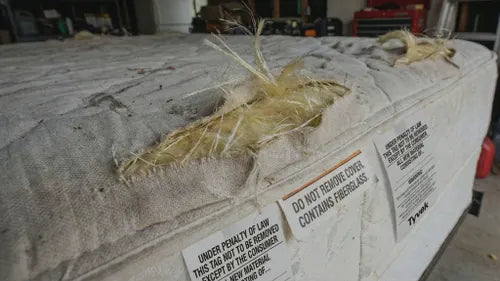
The fiberglass point deserves a flag of its own. A CertiPUR-US logo tells you nothing about whether a mattress uses fiberglass in its flame barrier — and fiberglass is the single component that worries non-toxic shoppers most. This is why the certification, valuable as it is, can't be your only check.
If you want certified foam and certified glue, a certified cover, and a guaranteed fiberglass-free build, that's exactly how the Original Mattress — a fully-certified, fiberglass-free build made in Tupelo, Mississippi — is constructed. It pairs CertiPUR-US foam with GreenGuard Gold glue and an OEKO-TEX cover, with zero fiberglass anywhere in the bed.
Does CertiPUR-US mean a mattress is "non-toxic" or "chemical-free"?
No. CertiPUR-US is a material content and emissions standard — not proof a mattress is "chemical-free," "natural," or medically safer. Polyurethane is a manufactured material that meets strict limits on harmful substances, not the absence of chemistry.
"CertiPUR-US® certified does not mean 'chemical-free' or 'natural.' Everything is made of chemicals (including you), and polyurethane foam is a manufactured material. What the certification does mean is that the foam meets strict, independently verified limits on harmful substances." — Casper Sleep Blog
Here's the accuracy guardrail that most articles skip: no randomized trial shows that CertiPUR-US certification improves human health outcomes. It's a material-content and emissions standard, not a clinical study. The honest way to read the science is as exposure context, not causal proof.
What that exposure research shows is real, though. A 2022 study in Environmental Science & Technology by Zhang et al. evaluated two new memory foam mattresses over 32 days in a simulated consumer-use environment and found both emitted measurable VOCs, concluding the mattresses were significant indoor VOC sources. And a 2022 study in the International Journal of Environmental Research and Public Health by Arfaeinia et al. detected 21 semivolatile organic compounds across 16 new children's mattresses.
Those findings explain why emissions screening matters — new mattresses can off-gas, and reducing that is worthwhile. Consumer Reports reaches a similar consumer-advocacy framing: shoppers reasonably want lower-emission materials. But none of this proves a CertiPUR-US logo makes you healthier. It means the foam meets defined limits — a sensible floor, not a medical promise.
This article is educational and not medical advice; it does not diagnose, treat, or make health claims about any product.
CertiPUR-US vs OEKO-TEX vs GreenGuard Gold — what's the difference?
CertiPUR-US certifies only the foam; OEKO-TEX Standard 100 certifies textiles like the cover; GreenGuard Gold certifies whole-product low emissions including adhesives. Together they cover far more of the mattress than any single mark does alone.
| Certification | What it certifies (scope) | Covers adhesives? | Covers cover / textile? | Covers fiberglass? |
|---|---|---|---|---|
| CertiPUR-US | Flexible polyurethane foam only — content, emissions, durability | No | No | No |
| OEKO-TEX Standard 100 | Textiles and fabrics — tested for harmful substances | No | Yes | No |
| GreenGuard Gold | Whole product — low chemical emissions, including adhesives | Yes | Partial (emissions from the assembled product) | No |
Notice no certification line has a "Yes" under fiberglass — that's a manufacturer disclosure question, not a certification one, which is why you have to ask it directly. For a fuller breakdown of how these marks stack, the industry overview from Spring Air on mattress certifications covers the same scope distinctions.
The practical move is to stack the certifications so each one plugs another's gap. CertiPUR-US handles the foam; GreenGuard Gold tackles whole-product emissions including the glue; OEKO-TEX covers the textiles you sleep against. A build like the Luxury Hybrid — fiberglass-free with certified foam and certified components — carries that layered approach, and the OEKO-TEX bamboo logic extends to bedding too, like the Enhanced Bamboo Sheet Set with OEKO-TEX certified textiles. One logo on the foam isn't the goal; coverage across the whole bed is.
How is CertiPUR-US foam actually tested and verified?
Foam samples are taken at the manufacturing stage and analyzed by independent, accredited laboratories for chemical content, VOC emissions, and durability — not at the finished-mattress stage. That timing is the key to understanding the certification's limits.
According to the CertiPUR-US Technical Guidelines (2023), foam samples are pulled at the manufacturing stage and tested by approved independent accredited laboratories. The program's about page reinforces that certified foam is "analyzed by independent, accredited laboratories for content, emissions, and durability."
The practical implication is the whole reason this article exists: testing happens before the foam becomes part of a mattress. The lab never sees the glue that will bond the layers, the cover that will wrap them, or the flame barrier that will be added. So the certification physically can't speak for those components — not because the program is weak, but because that's where its scope ends.
Bottom line: trust the CertiPUR-US mark as a verified statement about the foam. Then ask the manufacturer the separate questions it was never designed to answer.
How do I know if a whole mattress is actually safe?
Look for layered proof: certified foam, certified adhesive, a certified or OEKO-TEX cover, verified fiberglass-free construction, and transparent U.S. manufacturing you can trace. No single logo delivers all five — you have to check each one.
Use this five-step checklist on any mattress you're considering:
- Is the foam CertiPUR-US certified? This confirms the foam core meets content, emissions, and durability limits — the baseline.
- Is the glue covered by GreenGuard Gold? Adhesives are a common VOC source CertiPUR-US doesn't touch, so ask specifically about whole-product emissions.
- Is the cover OEKO-TEX certified? The textile against your skin all night should be tested for harmful substances, separately from the foam.
- Is it verifiably fiberglass-free? Because no certification answers this, get a direct, written statement from the manufacturer.
- Can you trace where it's made? A specific manufacturing location — a real city, not "designed in the USA" — signals a brand willing to stand behind its build.
This checklist works on any brand, and you don't need to buy anything to use it. It's the most useful thing to take from this article. If a mattress can't clear all five, you've found exactly where to ask harder questions before you commit. For a wider shopping framework, our 2026 mattress buying guide walks through firmness, type, and fit alongside materials.
If you'd rather skip the cross-checking, a triple-certified, fiberglass-free build is designed to clear every box at once. The Original Mattress, built fiberglass-free in Tupelo, Mississippi, pairs CertiPUR-US foam, GreenGuard Gold glue, and an OEKO-TEX cover — and you can compare it against the Luxury Hybrid or browse the full fiberglass-free mattress lineup. Every Nest & Wild mattress is made in Tupelo and is 100% fiberglass-free — a manufacturing fact you can confirm on the product pages.

Frequently asked questions about CertiPUR-US certification
Is CertiPUR-US certification enough to guarantee a non-toxic mattress?
No. CertiPUR-US certifies only the flexible polyurethane foam, not the adhesives, flame barrier, cover, or whether the mattress contains fiberglass. It's a strong baseline for the foam core, but a genuinely non-toxic mattress needs additional certifications like GreenGuard Gold and OEKO-TEX, plus a verified fiberglass-free build.
Does CertiPUR-US cover the flame barrier layer in my mattress?
No. The flame barrier is a separate component and falls outside CertiPUR-US, which certifies foam only. In some mattresses that barrier is fiberglass, and the certification says nothing about it. Always ask the manufacturer directly what the flame barrier is made of and whether the bed is fiberglass-free.
Are CertiPUR-US certified mattresses safe for babies and children?
CertiPUR-US confirms the foam meets strict content and emissions limits, which is reassuring, but it isn't a clinical safety study and only covers the foam. A 2022 study by Arfaeinia et al. detected 21 semivolatile compounds across 16 new children's mattresses, so for kids' beds, look for whole-product and textile certifications too.
What is the difference between CertiPUR-US and OEKO-TEX certification?
CertiPUR-US certifies the polyurethane foam inside a mattress, while OEKO-TEX Standard 100 certifies textiles — like the mattress cover or sheets — for harmful substances. They cover different layers of the same bed, which is why stacking both gives broader coverage than either one alone.
Can a mattress have CertiPUR-US certified foam but still contain harmful adhesives?
Yes. CertiPUR-US tests foam at the manufacturing stage and never evaluates the glue that bonds the layers, which is a common VOC source. To cover adhesives, look for GreenGuard Gold, which certifies low emissions from the whole assembled product, not just the foam.
Is CertiPUR-US a government regulation or a voluntary certification?
It's a voluntary certification, not a government regulation. CertiPUR-US is administered by the nonprofit Alliance for Flexible Polyurethane Foam, which launched the program in 2008 to combat substandard imported foams. No law requires a mattress to carry it, so its absence isn't proof of harm — and its presence only speaks to the foam.
Bottom line by shopper: If you only check one thing, check that the foam is CertiPUR-US — but don't stop there. Parents and chemically sensitive sleepers: insist on certified foam, GreenGuard Gold glue, an OEKO-TEX cover, and a written fiberglass-free guarantee. Anyone who wants all of that without the cross-checking: a triple-certified, fiberglass-free build made in Tupelo, Mississippi clears the whole checklist at once.