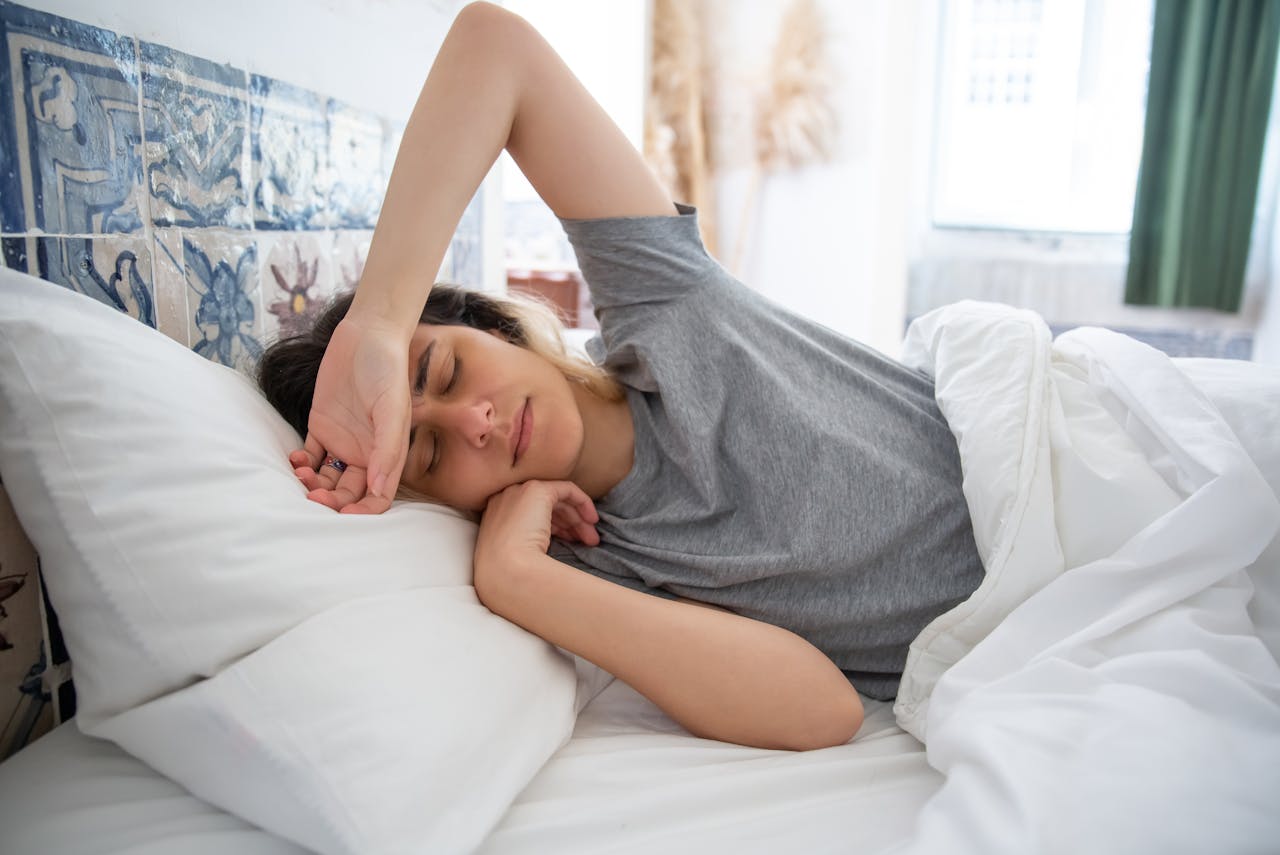


Waking up with a stiff, aching lower back? The most-recommended sleeping position for lower back pain is side-lying with a pillow between your knees, with back sleeping and a pillow under the knees a close second — and stomach sleeping the one to avoid. In a 472-adult observational study, back pain showed up in 53.2% of supine sleepers, 36.4% of side sleepers, and 10.4% of stomach sleepers — a reminder that the honest evidence is thinner than most articles admit.
Key takeaways
- Side sleeping with a pillow between the knees is the position most clinicians recommend for lower back pain; back sleeping with a pillow under the knees is the close runner-up.
- Stomach sleeping is the least back-friendly position because it extends the lumbar spine and keeps the neck rotated for hours.
- The research is mostly small, observational, and low-quality — no position is a proven cure for back pain.
- Position only works if the surface holds your spine neutral: NIH-summarized evidence suggests medium-firm mattresses may beat firmer ones for back pain.
- Severe, radiating, or worsening pain — or numbness and weakness — means see a doctor, not just swap pillows.
What is the best sleeping position for lower back pain?
The goal of all three positions is the same: keep the spine neutral. Neutral spinal alignment is the position where your head, ribcage, pelvis, and knees stack in a line so the spine keeps its natural curves without twisting. Mayo Clinic says side sleeping with the knees drawn up slightly and a pillow between the legs helps align the spine, pelvis, and hips and "takes pressure off your spine," while back sleeping with a pillow under the knees can relax back muscles and maintain the lower-back curve. Sleep Foundation ranks side sleeping with a slight knee bend and a knee pillow as the best option, with back sleeping next.
Bottom line: the position matters less than what it does — holding your spine neutral so the lower back bears less load overnight.

How strong is the evidence behind sleep-position advice, really?
The evidence is thin and observational: a handful of small, low-quality studies link supine and supported side-lying with less back pain, but none prove any position cures it. Treat position advice as symptom management, not a fix.
A 2025 systematic review of six observational studies, published in Musculoskeletal Care (Alshareef et al.), found supine sleep was associated with lower low-back-pain prevalence and prone (stomach) sleep with higher risk — but the authors stressed the studies were heterogeneous and low quality.
It gets thinner. A 2019 scoping review (Gordon et al.) screened 4,186 articles and found only four eligible studies. Side-lying looked generally protective, but the authors called the evidence preliminary and too sparse for firm recommendations.
And in that 472-participant observational study in the Journal of Chiropractic Medicine, back pain was actually most common among supine sleepers (53.2%) and least common among stomach sleepers (10.4%). That is correlation, not causation — people in pain may choose certain positions, not the other way around — which is exactly why no honest guide should promise a cure.
Across the best available research, no single sleeping position is proven to prevent or cure back pain. What the evidence supports is keeping the spine neutrally aligned and reducing pressure on the painful area.
Is side sleeping or back sleeping better for back pain?
Side sleeping with a pillow between the knees is generally considered best for lower back pain, with back sleeping a close second — both work only if they keep the spine neutral. The shared mechanism is reducing twist and preserving the lumbar curve.
Back sleeping has strong clinical backing for alignment specifically. As Gerard Girasole, MD, director of Orthopaedic Spine Surgery at St. Vincent's Medical Center, told Hartford HealthCare:
"Back sleeping is often considered the best position for overall spinal alignment." — Gerard Girasole, MD
The practical rule: pick the position that keeps your spine level and does not increase your pain, then use pillows to stop rotation. But a position only holds if the surface underneath cooperates. Too soft, and your hips sink and tip the pelvis out of neutral.
If you sleep on your back or stomach and wake up sagging into the bed, a firmer surface that won't let your hips drop is the fix — that's why we built the Original Mattress firmer, fiberglass-free, and made in Tupelo, Mississippi for exactly that neutral support. One honest caveat: no mattress or position cures back pain, and pain that persists or radiates needs a doctor's eye.

Why does sleeping on my stomach make my back hurt worse?
Stomach sleeping forces your lower back into extension and keeps your neck rotated for hours, both of which add strain instead of letting the spine rest. That mechanism is why prone shows up as the position most associated with worse back-pain outcomes.
When you lie face-down, your midsection sinks and your lumbar spine arches beyond its neutral curve, while your head turns to one side all night to breathe. Mayo Clinic says stomach sleeping can be hard on the back and recommends other positions when possible.
The fallback if you truly can't switch: Mayo Clinic advises placing a pillow under your hips and lower stomach to reduce lumbar extension. Some people tolerate stomach sleeping short-term with that modification — it's a bridge, not a destination, while you retrain toward your side or back.
How do I set up pillows for my sleeping position?
Put a pillow under your knees if you sleep on your back, or between your knees if you sleep on your side — both keep the spine, pelvis, and hips aligned and take pressure off the lower back.
- Back sleepers — pillow under the knees. Mayo Clinic says this relaxes the back muscles and helps maintain the lower-back curve. For extra support, tuck a small rolled towel under your waist to fill the lumbar gap.
- Side sleepers — pillow between the knees. Draw your legs up slightly and place a firm pillow between your knees so your top leg doesn't drag your pelvis into a twist. Mayo Clinic notes this aligns the spine, pelvis, and hips.
- Set your head pillow to keep the neck level. Mayo Clinic says the pillow should keep your neck aligned with your chest and back — side sleepers usually need more height to fill the shoulder gap; back sleepers do better with medium or low height.
Common errors that undo the setup: a head pillow too high or low that kinks the neck, knees not separated enough (the pelvis rolls forward), and the top arm dragging the shoulder down. If you sleep on your side most nights, our guide on side-sleeping support and pressure relief walks through fine-tuning shoulder and hip alignment.
Which position is best for my specific situation?
Match the position to your pain pattern: side-lying with a knee pillow suits most sciatica, pregnancy, and reflux cases; back sleeping with knee support helps mechanical low-back pain. Here's how each situation breaks down.
- Sciatica / shooting leg pain: Side-lying with a pillow between the knees, avoiding the painful side; back sleeping with a knee pillow is the next option. Spine-health advises people with sciatica to avoid sleeping on the side that hurts more and to avoid stomach sleeping. Not for you if either side worsens the leg pain — try back sleeping and get evaluated.
- Pregnancy: Side sleeping with a pillow between the knees, avoiding twist and abdominal strain. Not for you if you've been given specific guidance by your OB — pregnancy positioning can be individual, so follow your provider first.
- Reflux or snoring plus back pain: Side sleeping is the best compromise, since flat back sleeping can worsen both reflux and snoring. If you must sleep on your back, a slight torso recline helps. Not for you if reflux is severe — that needs medical management, not just a pillow.
- Recovering from a back injury: The safest choice is whatever keeps the spine neutral and non-twisted without increasing pain. Not for you to self-manage if pain followed a fall, lift, or twist — see a doctor before experimenting.
Does my sleeping position or my mattress matter more?
Both matter — position only works if the surface holds your spine neutral. NIH-summarized evidence suggests medium-firm mattresses may reduce back pain versus firmer ones. Fix the position, but don't ignore the bed under it.
The NIH evidence summary on therapeutic mattresses reports that one systematic review of nine studies found medium-firm mattresses may reduce back pain and improve sleep quality compared with firmer ones. The mechanism is the same alignment problem: too soft and your hips sink, bending the spine; too firm and pressure gaps open under the lumbar curve.
A quick self-test: if your back pain is worse while you're lying down and eases after you get up or sleep somewhere else, that points to the mattress and setup — not a fixed injury. Pain that stays constant regardless of surface is less likely to be mattress-driven.
Here's how that maps to construction. Side sleepers need coil support plus real pressure relief at the shoulder and hip so the spine stays level — that combination is what the Luxury Hybrid delivers, pairing a supportive coil base with a contouring comfort layer. Back and stomach sleepers do better on the firmer Original Mattress. Not sure which feel fits you? Our mattress firmness guide breaks it down by sleep style. Honest note: no mattress cures back pain — it just removes one obstacle to a neutral spine.
Can an adjustable base help with back pain, and how should I set it?
An adjustable base can help if it keeps your spine neutral: for back sleepers, raise the torso slightly and elevate the knees; side sleepers keep a pillow between the knees. The base is a tool for neutral posture, not a cure.
Elevating the head and knees mimics Mayo Clinic's pillow-under-the-knees recommendation — it relaxes the back muscles and supports the lumbar curve without you having to stack pillows. A slight torso incline also eases snoring and reflux without forcing flat back sleeping on people who can't tolerate it. One limit: don't use a base to make stomach sleeping comfortable, since that position strains the back regardless of incline.
If knees-up back sleeping, reflux, or snoring describe your nights, the Adjustable Base is the elevation upgrade that dials in head-and-knee support and pairs with the position-and-firmness matrix below. Honest trade-off: adjustable-base benefits are largely comfort-based rather than proven in trials, and red-flag or persistent pain still needs a doctor.
How do I match my position to the right firmness and base setting?
Use the Position + Surface + Setting matrix: it maps each sleeper type to a position and pillow setup, a firmness, a Nest & Wild product, a base setting, and who it's not for. Read each row on its own.
| Sleeper type | Best position + pillow setup | Recommended firmness | Nest & Wild product | Adjustable-base setting | Who it's NOT for |
|---|---|---|---|---|---|
| Back sleeper (mechanical LBP) | On back, pillow under the knees; optional towel under waist | Firmer / medium-firm — no hip sink | Original Mattress | Slight torso lift, knees elevated | People with reflux or snoring who worsen flat on their back |
| Stomach sleeper | Pillow under hips/lower stomach (least ideal — transition off if you can) | Firmer to limit lumbar extension | Original Mattress | Flat | Anyone with existing lower-back pain — this is the position to move away from |
| Side sleeper | On side, knees drawn up, pillow between knees | Coil support + pressure-relieving comfort layer | Luxury Hybrid | Neutral flat, keep knee pillow | Shoulder-pain sleepers who can't offload the down-side shoulder |
| Sciatica | Side-lying off the painful side, pillow between knees; back with knee pillow next | Support that avoids sag; hybrid for side, firmer for back | Luxury Hybrid or Original Mattress | Knees elevated if back sleeping | Anyone whose leg pain increases in the chosen position — reassess and see a doctor |
| Reflux / snoring + back pain | Side sleeping with knee pillow; slight recline if back sleeping | Whatever keeps the spine level for your side | Luxury Hybrid + Adjustable Base | Torso raised to reduce reflux/snoring | Severe reflux needing medical treatment, not positioning alone |
Every Nest & Wild mattress is CertiPUR-US, GreenGuard Gold, and OEKO-TEX certified, and 100% fiberglass-free — which matters more than most shoppers realize — all built in Tupelo, Mississippi.
When should I see a doctor instead of changing sleeping positions?
See a doctor if back pain is severe, keeps worsening, lasts more than a few weeks despite position changes, or comes with red-flag symptoms like leg weakness or numbness. Sleep-position changes are self-care, not a diagnosis.
Stop the trial-and-error and get evaluated if you notice any of these:
- Pain that radiates down one or both legs.
- Numbness, tingling, or weakness in the legs or feet.
- Any change in bowel or bladder control.
- Pain that started after a fall, heavy lift, or twist.
- No improvement after a few weeks of consistent position and pillow changes.
Mayo Clinic frames position changes as a comfort strategy, not a substitute for evaluation when pain persists or carries warning signs. No mattress, base, or position is a cure — the honest version of this advice always ends with "when in doubt, ask a clinician."
Common questions about sleeping positions for back pain
How long does it take to adjust to a new sleeping position before back pain improves?
There's no proven timeline. Clinical guidance suggests trying the new position consistently for several nights to a couple of weeks while keeping the spine neutral with pillow support. Cleveland Clinic describes neutral posture letting stretched tissues creep back toward normal overnight. If pain worsens or won't budge, the position may not fit you.
Should I put the pillow between my knees or under my knees?
Between the knees if you sleep on your side, under the knees if you sleep on your back. Both keep the spine, pelvis, and hips aligned. Mayo Clinic ties the between-the-knees setup to side alignment and the under-the-knees setup to relaxing the back muscles and preserving the lumbar curve.
Is a memory foam or hybrid mattress better for keeping my back supported in one position?
A hybrid is generally the better default because its coil base resists sag and stays responsive while a comfort layer cushions pressure points. Firm-enough memory foam can also work. The bigger issue is neutral alignment: the surface should neither bottom out nor leave a gap under your lower back.
Is a firmer mattress always better for back pain?
No. The NIH evidence summary notes medium-firm mattresses may reduce back pain and improve sleep versus firmer ones in some populations. Very firm surfaces can create pressure gaps under the lumbar curve; the right firmness balances support with pressure relief for your position and body.
What's the safest sleeping position for back pain during pregnancy or after a back injury?
Usually side-lying with a pillow between the knees, which keeps the spine, pelvis, and hips aligned. During pregnancy, Mayo Clinic recommends side sleeping with a leg pillow. After an injury, prioritize a neutral, non-twisted posture and see a doctor before experimenting with positions.
Your quick decision rule: Back or stomach sleeper who sinks into a soft bed — Shop the Original Mattress for firmer, fiberglass-free neutral support. Side sleeper needing shoulder-and-hip pressure relief — Shop the Luxury Hybrid. Want knees-up elevation for reflux or snoring — Explore the Adjustable Base. And if your pain is severe, radiating, or lasting more than a few weeks, see a doctor first — no mattress or position is a cure.