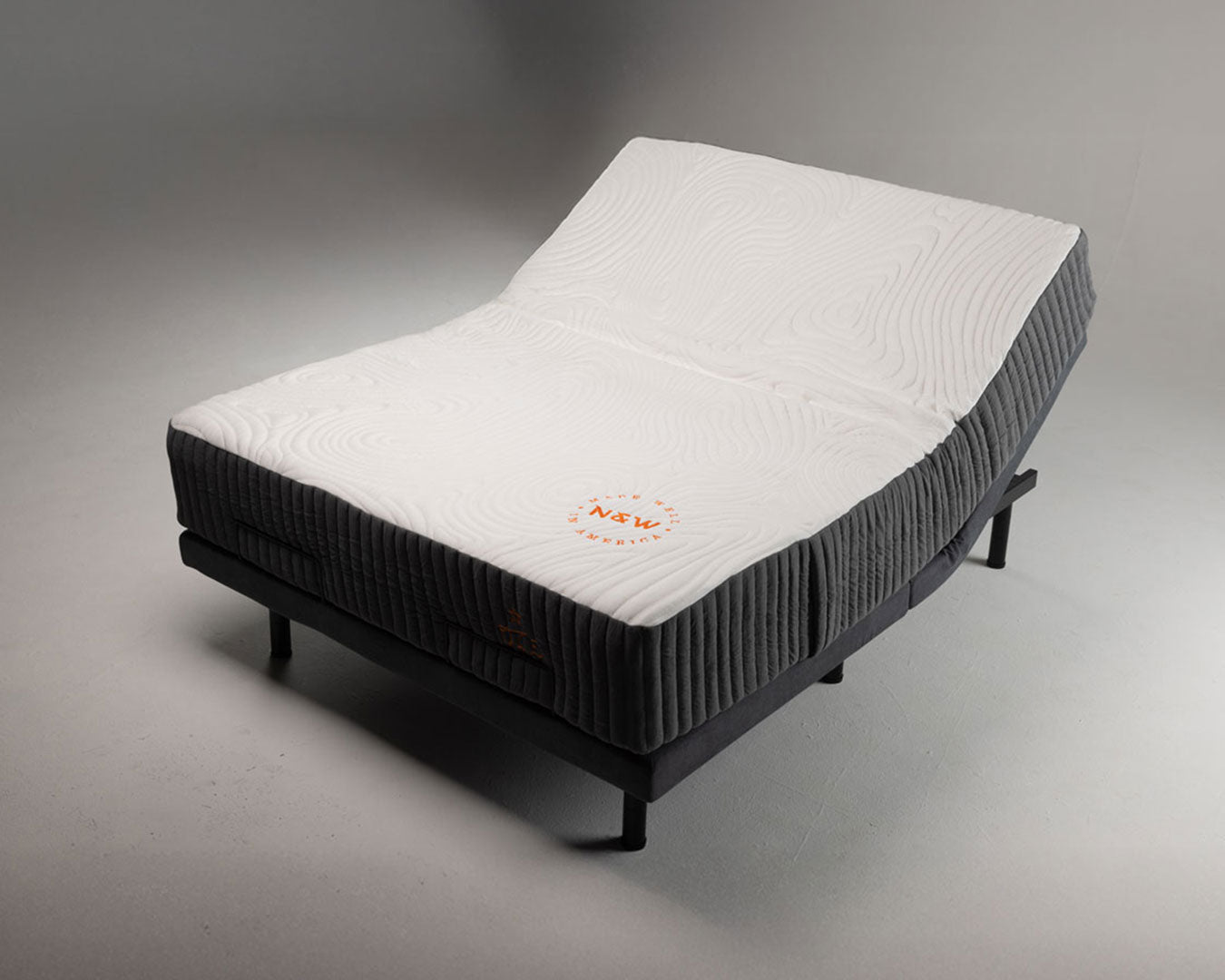


The best luxury hybrid for couples with different sleep preferences pairs a motion-absorbing comfort layer with individually pocketed coils — and when your needs truly clash, a split-king setup so each side can differ entirely. That combination is what keeps your partner's 2 a.m. roll from dragging you out of deep sleep, which a 1999 sleep-lab study tied directly to lost Stage 3/4 rest. The Luxury Hybrid Mattress, Fiberglass-Free – Nest & Wild is a real-world example of that spec, with the added bonus of verified non-toxic materials.
Key takeaways
- Motion isolation — a mattress's ability to absorb movement instead of spreading it — is the single most important attribute for couples who wake each other up.
- Pocketed coils plus a motion-absorbing comfort foam neutralize movement far better than interconnected innerspring units.
- A split king (two mattresses on one base) is the only truly "ironclad" fix when partners want different feels.
- No peer-reviewed trials compare specific hybrid models head-to-head — recommendations rest on independent lab testing plus material mechanism, not clinical data.
- Fiberglass-free, CertiPUR-US construction doesn't change motion performance, but it changes what's next to your body for eight hours a night.
What is motion isolation, and why does it actually matter for couples?
Motion isolation is a mattress's ability to absorb movement and stop it from spreading across the bed — and lab evidence shows that transferred movement measurably fragments deep sleep. The Sleep Foundation defines it precisely in its motion-isolation testing methodology, where a mattress's response to localized movement is measured to see how far it travels.
Why does that matter? Because partner movement doesn't just annoy you — it changes your sleep architecture. A foundational 1999 sleep-lab study indexed on PubMed found that lateral motion transferred across a mattress was associated with a significant increase in light Stage 1 sleep and a significant decrease in deep Stage 3/4 sleep. In plain terms: every transmitted bounce nudges you out of the restorative stages and into shallow sleep.
The evidence that partner presence reshapes sleep is more recent, too. A 2020 polysomnography study in Frontiers in Psychiatry of 12 young healthy couples found that bed-sharing altered sleep physiology — increasing and stabilizing REM and synchronizing sleep stages between partners. Sharing a bed isn't neutral; it changes how you sleep, which is exactly why minimizing the disturbance your partner can cause is worth investing in.
"Motion isolation is a mattress's ability to absorb movement and prevent it from spreading across the bed."
One honest caveat up front: there are no peer-reviewed trials comparing specific luxury hybrid models for motion isolation. The strongest science is indirect — it proves that motion transfer disrupts sleep, not that Mattress A beats Mattress B. Product-level recommendations in this guide rest on independent lab testing plus material mechanism, and we'll flag that distinction throughout. If you want the deeper science on why protecting Stage 3/4 sleep matters, our piece on why deep sleep is the key to reducing stress goes further.

How do luxury hybrids actually reduce motion transfer?
A hybrid neutralizes movement two ways: a soft comfort foam absorbs surface motion at the point of impact, while individually pocketed coils flex on their own instead of transmitting movement across the whole bed like a connected innerspring. Most "best for couples" guides name the winners but skip this mechanism — so here it is.
The comfort layer does the first job
When your partner shifts, the top comfort foam compresses locally and dissipates that energy before it can ripple outward. Memory and high-density polyfoam are especially good at this because they're slow to respond — they soak up the jolt rather than springing it back. Mattress Clarity, which tested 500+ beds for its best mattress for couples roundup, found that "lofty foam layers isolate motion extremely well." "Lofty" here means thick, plush comfort layers that absorb more before motion reaches the support core.
The coils do the second job
The support layer is where hybrids separate themselves. The difference comes down to how the coils are built:
- Pocketed (individually wrapped) coils: each spring sits in its own fabric pocket and compresses independently. Press down on one side and the coils there move without dragging their neighbors — so movement stays local.
- Interconnected (Bonnell-style) innerspring: the coils are wired together into a single grid, so they act as one transmitting unit. Movement on one side travels straight across the bed.
Picture the foam-plus-coil stack as two filters in series: the comfort foam catches the surface jolt, and the pocketed coils catch whatever energy makes it down to the support core. That layered approach is the core reason hybrids reduce partner disturbance better than a traditional connected innerspring — and it's worth understanding before you shop, which our guide to finding your perfect bed walks through in more detail.
Bottom line: the more responsive and contouring the comfort layer, and the more independently the coils move, the less your partner's movement reaches your side. That's the whole game.
Does fiberglass-free, CertiPUR-US construction matter for couples?
It matters for what's next to your body for eight hours a night: CertiPUR-US certifies that foams are made without certain harmful chemicals, and fiberglass-free means there are no hidden glass fibers in the fire barrier. It does not change motion-isolation performance — but for a bed two people sleep on nightly for years, material safety is a legitimate decision factor sitting right alongside performance.
Here's the context most guides skip. Many mainstream mattresses use a thin fiberglass sock as the fire barrier beneath the cover. It's cheap and effective at its job — but if a cover is unzipped and removed (which some brands warn against), those microscopic glass fibers can escape into bedding and the room. A genuinely fiberglass-free build avoids that risk entirely.
The certifications worth knowing:
- CertiPUR-US — certifies foams are made without ozone depleters, certain flame retardants, heavy metals, formaldehyde, and high-VOC content.
- GreenGuard Gold — verifies low chemical emissions for indoor air quality.
- OEKO-TEX — tests textiles for harmful substances.
Nest & Wild's Luxury Hybrid pairs strong motion isolation with all three certifications and is 100% fiberglass-free, built in Tupelo, Mississippi. That combination — low motion transfer and verified non-toxic, American-made construction — is exactly what the lab-favorite competitors rarely lead with. If material safety is a priority, our fiberglass-free mattress hub explains how to verify a brand's claims rather than take them on faith.

Which luxury hybrid mattresses are best for couples, compared?
Top lab-tested hybrids for couples include the Nest & Wild Luxury Hybrid, Winkbed, Bear Elite Hybrid, Nectar Luxe, DreamCloud Premier, and Nolah Evolution — each strong on different metrics. The table below pulls each verdict from the independent lab that tested it. Remember the caveat: these rankings come from testing-lab methodology and material mechanism, not peer-reviewed comparative trials, which don't exist for specific models.
| Model | Motion isolation | Cooling | Edge support | Best for | Fiberglass-free? |
|---|---|---|---|---|---|
| Nest & Wild Luxury Hybrid | Strong (pocketed coils + CertiPUR-US comfort foam) | Coil airflow + breathable cover | Solid | Couples wanting isolation + verified non-toxic materials | Yes — verified, plus GreenGuard Gold & OEKO-TEX |
| Winkbed | High | Excellent (perfect cooling score, NapLab) | Strong | Hot sleepers; pressure relief | Not confirmed in research |
| Bear Elite Hybrid | High (Forbes Vetted) | Good | Strong (Forbes Vetted) | Back-pain sleepers; varied positions | Not confirmed in research |
| Nectar Luxe | Very high ("lofty foam," Mattress Clarity) | Moderate | Moderate | Restless-partner couples | Not confirmed in research |
| DreamCloud Premier | High (Mattress Nerd pick) | Good | Strong | Couples wanting a firmer feel | Not confirmed in research |
The lab credentials behind those verdicts: NapLab calls the Winkbed "the highest performing and best hybrid mattress we've tested to date (400+ tested)" in its best hybrid mattress testing of 208+ hybrids. Forbes Vetted notes the Bear Elite Hybrid "scored highly in performance categories that matter most for couples: motion isolation, edge support" in its best mattresses for couples guide. Mattress Nerd selected the DreamCloud Premier as its best mattress for couples for motion isolation, and NCOA highlights the Nolah Evolution in its best hybrid mattress roundup.
Where competitor cells read "not confirmed in research," that's deliberate — we won't print a fiberglass spec we can't verify. If what's next to your body for eight hours matters to you, the fiberglass-free Luxury Hybrid is the pick that pairs lab-grade motion isolation with CertiPUR-US, GreenGuard Gold, and OEKO-TEX certification — a combination none of the lab favorites lead with. It ships with an adjustment period so you can confirm the feel at home.
What if you and your partner want totally different feels?
A split-king setup — two separate mattresses on one frame — is the only ironclad fix when preferences truly clash, because there's literally no shared surface for motion to travel across. The testing community is blunt about it. As one user summed it up in a mattress forum thread on preventing motion transfer:
"Another vote for split king — this setup is the only ironclad solution to stop the wake-ups from motion."
A split king uses two twin-XL mattresses side by side, so each partner picks their own firmness and feel. One can run soft and plush for side-sleeping; the other can run firm for back support — and neither feels the other move.
Add an adjustable base and each side personalizes incline, too
Pair a split king with an adjustable base and the personalization goes further: one partner can raise their head for snoring or late-night reading while the other stays flat. Each side adjusts independently. An adjustable bed base with zero-gravity and snore relief is the tool that lets two sleepers truly run one bed on their own terms.
The honest trade-off: a split king costs more than a single mattress — you're buying two — and there's a center gap between the two pieces unless you bridge it. For couples whose preferences only differ a little, one well-built hybrid is usually the better value. Reserve the split king for partners whose needs genuinely diverge.
How do you match the mattress to your specific situation?
Hot sleepers need breathable covers and coil airflow; back-pain and side sleepers need contouring pressure relief; restless-partner couples should prioritize motion isolation above every other metric. Here's how to weight your choice by situation.
Hot sleepers who share a bed
Coils create vertical airflow that foam-only beds can't match, so a hybrid is already a head start on cooling. Pair it with a breathable cover and cool-sleeping bedding. Plush, deep-contouring foam isolates motion best but can trap heat — so a hot couple should accept slightly less contouring in exchange for airflow. A set of breathable bamboo sheets helps wick heat away from the surface, and our breakdown of cooling mattress materials that actually work separates real cooling tech from marketing.
Skip the deepest-contouring plush build if you wake up sweating — that comfort layer is working against you.
Couples with back pain or side sleepers
Pocketed coils plus a contouring comfort layer support spinal alignment by letting the hips and shoulders sink in while keeping the spine neutral. Forbes Vetted singled out the Bear Elite Hybrid for back support and accommodating multiple sleeping positions, which is the profile back-pain and side sleepers want. A medium-firm-to-firm hybrid with a responsive top layer usually serves a back-pain partner and a side-sleeping partner without forcing a split king. Our firmness guide helps you find the overlap.
Skip a very plush build if one of you sleeps on their stomach — it lets the hips sag and strains the lower back.
Light or restless-partner couples
If one of you wakes at every move, rank motion isolation above cooling and edge support. This is the couple for whom a lofty-foam-over-pocketed-coils build pays off most — and, in the extreme, the split king. Want a non-hybrid option on a tighter budget? The fiberglass-free Original Mattress still isolates motion well in an all-foam build.
Skip an all-foam bed if you also run hot — foam without coils sleeps warmer.
Do edge support and cooling conflict with motion isolation?
Sometimes yes: the deep-contouring foam that isolates motion best tends to sleep warmer and feel softer at the perimeter, while firmer, cooler, edge-supported builds may transmit slightly more motion. There's no single mattress that maxes out every metric — so couples win by ranking priorities, not chasing perfection.
The tensions, plainly:
- Plush isolating foam vs. cooling: the more you sink in, the more your body is surrounded by heat-trapping material.
- Plush isolating foam vs. edge support: a soft perimeter that absorbs motion also collapses more when you sit on the edge.
- Firm, cool, edge-supported build vs. isolation: firmer surfaces bounce more energy back, transmitting a touch more movement.
So weight the trade-off to your situation. A restless-partner couple weights isolation and lives with a touch less edge support. A hot couple weights airflow and accepts slightly less contouring. Couples who sit on the bed's edge to dress, or share a smaller bed, weight perimeter support. If your priorities point away from coils and contouring entirely, an all-foam Original Mattress may be the more honest fit than forcing a hybrid to do everything.
The Sleep Foundation's motion-isolation methodology measures isolation in isolation, so to speak — it won't tell you how a bed balances these competing demands. That part is yours to decide by priority.
How much should a luxury motion-isolation hybrid cost?
Top-tier motion-isolation hybrids generally run from the high hundreds into the low-to-mid thousands for a queen, depending on materials, coil count, and certifications. The lab-favorite models — Winkbed, Nolah, Bear — sit in that range, with split-king configurations costing more because you're buying two mattresses.
What actually drives the price:
- Coils — gauge, count, and whether they're zoned and individually pocketed.
- Foam quality — density and how the comfort layers are engineered to isolate motion.
- Cover and cooling materials — breathable, durable textiles cost more.
- Certifications — CertiPUR-US, GreenGuard Gold, OEKO-TEX, and genuine fiberglass-free construction add cost but verify what's inside.
Frame it by use, not sticker. A bed two people sleep on for roughly a third of every day, for years, is a long-horizon purchase — and verified non-toxic, American-made construction is part of the value, not an upsell. Our look at why USA-manufactured mattresses save you money over the long run makes the durability-and-value case in full. For current Nest & Wild pricing and configurations, check the Luxury Hybrid product page directly.
Frequently asked questions about luxury hybrids for couples
Which luxury hybrid is best for couples with different sleep preferences?
The best choice pairs a motion-absorbing comfort foam with individually pocketed coils so each partner's movement stays local. Lab-tested standouts include the Winkbed, Bear Elite Hybrid, Nectar Luxe, and DreamCloud Premier. If verified fiberglass-free, CertiPUR-US construction also matters to you, the Nest & Wild Luxury Hybrid pairs that isolation with certified non-toxic materials.
Is a split king better than a single mattress for motion isolation?
Yes, for motion isolation specifically. A split king uses two separate mattresses on one base, so there's no shared surface for movement to travel across — the testing community calls it the only "ironclad" fix. The trade-offs are higher cost and a center gap. For couples whose preferences differ only slightly, one well-built hybrid is usually the smarter value.
Do CertiPUR-US foams actually improve motion isolation?
No — CertiPUR-US is a chemical-content certification, not a performance metric. It verifies foams are made without certain harmful substances; it says nothing about how well a bed absorbs movement. Motion isolation comes from foam responsiveness and pocketed-coil construction. CertiPUR-US matters for material safety, which is a separate (and legitimate) reason to choose a mattress.
What's the best hybrid for hot sleepers who share a bed?
Hot couples should prioritize coil airflow and a breathable cover over the deepest-contouring foam, since plush isolating layers trap heat. NapLab gave the Winkbed perfect cooling scores after testing 400+ hybrids. Pairing any breathable hybrid with moisture-wicking bamboo sheets helps, and accepting slightly less contouring in exchange for airflow is the right trade for sweaty sleepers.
What's the best hybrid for couples where one partner has back pain?
Look for pocketed coils under a contouring comfort layer that keeps the spine neutral while cushioning hips and shoulders. Forbes Vetted singled out the Bear Elite Hybrid for back support across sleeping positions. A medium-firm hybrid usually satisfies a back-pain partner and a side-sleeping partner at once. An adjustable base adds targeted incline relief for back and joint pain.
Do edge support and motion isolation conflict in a hybrid mattress?
Often, yes. The plush foam that isolates motion best also makes the perimeter softer, so a bed can't always maximize both. Couples who sit on the edge or share a smaller bed should weight edge support; restless-partner couples should weight isolation. Recognizing the trade-off and ranking your priorities matters more than chasing a mattress that does everything.

The bottom line: which should couples buy?
For most couples, one well-built luxury hybrid — a motion-absorbing comfort layer over individually pocketed coils — handles partner disturbance well enough that you stop waking at every roll. For partners with genuinely different feels, go split king, ideally on an adjustable base so each side sets its own firmness and incline. Hot couples weight airflow; back-pain and side sleepers weight contouring; restless-partner couples weight isolation above all.
One last honest note: these recommendations rest on independent lab testing plus material mechanism, not head-to-head clinical trials, because none exist for specific models. What the science does prove is that transferred motion fragments deep sleep — so reducing it is worth doing right. If you want strong motion isolation plus verified fiberglass-free, CertiPUR-US, GreenGuard Gold, and OEKO-TEX construction built in Tupelo, Mississippi, the Luxury Hybrid is the pick that delivers both — and you can confirm the feel at home during the adjustment period. Still weighing your options? Compare the full lineup of fiberglass-free mattresses before you decide.