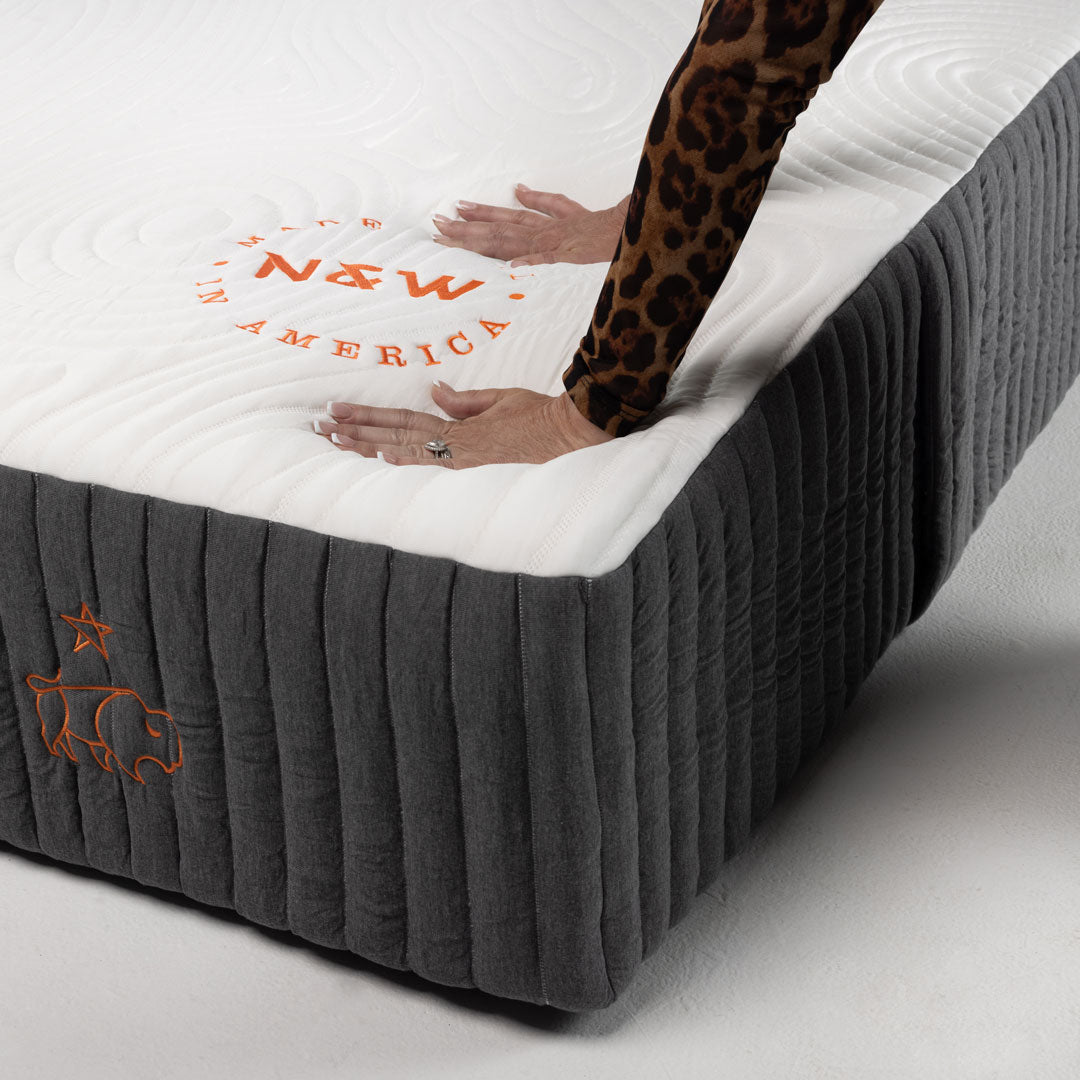


Neither hybrid nor memory foam wins outright for a side sleeper with back pain. Across a 2021 systematic review of 39 articles, a 2022 evidence review of 9 studies, and a 2003 Lancet trial, the pain-relief signal traces to one thing — medium-firm support that keeps your spine neutral — not the coil-versus-foam label. This guide grades every claim by how strong its evidence actually is, so you know what's proven and what's just plausible.
Key takeaways
- Firmness, not construction, drives back-pain relief. Medium-firm is the most consistently supported target in the clinical literature.
- Memory foam usually contours tighter at the shoulder and hip; hybrids usually sleep cooler and support edges and heavier bodies better — but the cooling and durability edges are engineering logic, not clinical proof.
- No published RCT directly compares hybrid vs memory foam in side sleepers with back pain — anyone claiming a clear winner is overstating the data.
- Both types commonly last 7–10 years; hybrids resist deep sagging longer.
- Chase a medium-firm feel that keeps your spine neutral first; pick construction second based on temperature, body weight, and whether you share a bed.
Hybrid or memory foam for a side sleeper with back pain — what actually matters?
Neither type is universally better. The clinical evidence points to medium-firm support and neutral spinal alignment as the real driver — not the material label. A 2021 systematic review in the Journal of Orthopaedics and Traumatology of 39 articles concluded that medium-firm mattresses promote comfort, sleep quality, and spinal alignment, and a 2022 evidence review on NCBI Bookshelf summarizing 9 studies found medium-firm may reduce back pain versus firmer beds.
That reframes the whole decision. The right question isn't "hybrid or foam?" — it's "which build keeps my spine neutral while cushioning my shoulder and hip?" Both can hit medium-firm. This post grades every claim by evidence strength so you can decide by your body, not by marketing. One build that meets the medium-firm target without off-gassing worries is the fiberglass-free Luxury Hybrid — more on where it fits, and where all-foam fits better, below.

What is the difference between a hybrid mattress and a memory foam mattress?
A hybrid is a foam comfort layer over a coil support core; memory foam is an all-foam build that conforms to heat and pressure. The two solve support differently, and the label alone won't tell you how a bed feels.
A hybrid mattress is a mattress with a foam comfort system built over an innerspring or pocketed-coil support core; the comfort layer may be memory foam, latex, polyfoam, or microcoils, per the Sleep Foundation's memory-foam-vs-hybrid guide. Memory foam is viscoelastic polyurethane foam that responds to heat and pressure, molding slowly to the body and rebounding slowly once pressure lifts.
The core mechanical difference is support architecture. Coils deliver lift, edge support, and airflow; foam density delivers deep contouring and motion isolation. One caution: some sellers use "hybrid" loosely, and plenty of hybrids put memory foam in the comfort layer — so the actual layer construction, not the label, decides the feel. You can see both builds side by side in the Original foam vs Luxury Hybrid lineup.
How do you grade a mattress claim by evidence strength? The 3-Tier Evidence Test
Sort every mattress claim into three tiers — clinically supported, engineering inference, or evidence gap — so you know what's proven versus what's merely plausible. Most competitor articles present Tier 2 claims with Tier 1 confidence; this is the honest correction.
- Tier 1 — Clinically supported: medium-firm support, neutral spinal alignment, and pressure distribution. These are backed by systematic reviews and randomized trials.
- Tier 2 — Engineering inference: cooling, edge support, motion isolation, responsiveness. Mechanically sound and consistent, but not proven by clinical outcome trials.
- Tier 3 — Evidence gap: no published head-to-head RCT compares hybrid versus memory foam in side sleepers with back pain. Any blanket "hybrid wins" verdict lives here.
The 2022 NCBI evidence review makes the point plainly: its 9 studies compared firmness levels, not construction labels. Keep this lens handy — it's the difference between a confident buying decision and a marketing-shaped one.

How firm should a mattress be for a side sleeper who wakes up with back pain?
Medium-firm — the middle of the scale. Aim for the softest surface that still keeps your spine neutral without letting your pelvis sink. That balance matters more than any material.
The evidence is consistent here. A 2026 orthopedic review in the Journal of Orthopaedics and Traumatology spanning 47 studies most consistently favored medium-firm surfaces for pressure distribution and lower back-pain intensity, and the NCBI review reported intermediate firmness improved disability more than firm mattresses.
"Results of this systematic review show that a medium-firm mattress promotes comfort, sleep quality and rachis alignment." — Caggiari et al., systematic review, 2021
The trade-off is simple. Too soft: your pelvis sinks, your spine curves, and low-back pain worsens. Too firm: shoulder and hip pressure builds because those points can't sink in, pulling your spine out of neutral the other way. Body weight and shape nudge the ideal feel slightly within the medium-firm band, but no high-quality trial gives a precise weight cutoff. If you want a plain-English walkthrough of picking that feel, our simple guide to choosing the right mattress covers it. (Tier 1 — clinically supported.)
Does memory foam relieve shoulder and hip pressure better than a hybrid?
Usually yes, when deep contouring is the priority — memory foam conforms closer to the body and redistributes load at the shoulders and hips. But hybrid pressure relief varies widely by comfort-layer thickness.
The Sleep Foundation's pressure-relief methodology states memory foam "typically excels at pressure relief," while hybrids deliver "average to above-average pressure relief depending on the composition of the comfort system." Pressure distribution itself is a Tier 1 concern for side sleepers; the specific foam-versus-hybrid margin is Tier 2 engineering nuance.
Body weight flips the answer, too. The Sleep Foundation's Silk & Snow Hybrid review found a plush model suited side sleepers under 130 pounds while the standard model fit those over 130 pounds — proof that firmness and comfort-layer thickness change hybrid outcomes more than the label. The honest trade-off: deeper contouring can mean more trapped heat and slightly harder repositioning.
Do hybrid mattresses keep your spine more aligned than all-foam mattresses?
No clear evidence shows hybrids align the spine better across the board. Firmness and support design drive alignment more than the coil-versus-foam label.
This is where most comparison articles overreach. The Caggiari 2021 review ties alignment to medium firmness, not construction. The mechanism is load distribution: too soft and the pelvis drops; too firm and shoulders and hips can't sink enough — both pull the spine out of neutral. A well-built zoned all-foam mattress can hold the spine as neutral as a hybrid.
Bottom line: the head-to-head "hybrids align better" claim is a Tier 3 evidence gap. The firmness driver behind alignment is Tier 1. Buy the feel that keeps you neutral, and the construction becomes a secondary preference.
Hybrid vs memory foam: how do they compare feature by feature?
Hybrids lead on cooling, edge support, and durability; memory foam leads on contouring and motion isolation. Both can hit medium-firm — the feature that actually governs back pain.
| Feature | Hybrid | Memory Foam | Evidence tier |
|---|---|---|---|
| Support architecture | Coil core + foam comfort layer (lift, responsiveness) | Foam density + viscoelastic contouring | Definitional |
| Pressure relief (shoulder/hip) | Average to above-average, varies by comfort layer | Typically excels at contouring | Tier 1 (distribution) + Tier 2 (margin) |
| Spinal alignment for side sleepers | Good when medium-firm | Good when medium-firm | Tier 1 (firmness), Tier 3 (head-to-head) |
| Cooling / airflow | Cooler — open coil core moves air | Retains more body heat | Tier 2 (engineering inference) |
| Edge support | Stronger — coil-reinforced perimeter | Softer at the edges | Tier 2 |
| Motion isolation | Good, slightly more transfer | Best — absorbs movement | Tier 2 |
| Durability | ~7–10 years; resists deep sag | ~6.5–7.5 years; softens into impressions | Tier 2 (secondary sources) |
| Best-for body weight | Heavier bodies (coil support) | Lighter/average bodies wanting deep hug | Tier 2 |
| Materials / off-gassing | Foam + coils; certifications vary by brand | All-foam; certifications vary by brand | Brand-specific |
Durability figures reflect broad estimates: Tom's Guide cites roughly 7–10 years for hybrids, and Mattress Clarity puts foam around 6.5–7.5 years — both model-dependent, not category law. You can compare both builds in the Nest & Wild mattress collection.
Which sleeps cooler for a hot sleeper: a hybrid with coils or memory foam?
A hybrid, mechanically — the open coil core lets air move instead of trapping heat in solid foam. Memory foam's denser structure retains more warmth near the surface.
The clearest data point: an older Leggett & Platt study, as reported by Furniture Today, found innersprings dissipate heat about 28% better than non-innerspring surfaces. That's real support for the airflow advantage — but it's Tier 2 engineering inference, not clinical proof.
An honesty flag worth stating: some articles cite figures like "78% of hot sleepers slept cooler on hybrids" or exact °F thermal deltas. The primary sources behind those numbers weren't verified in our research, so we've deliberately left them out. Trust the mechanism, not the unverified stat.
If you run warm, breathable sheets stack the deck — a coil core plus a moisture-moving cover moves more heat than either alone. Our guide to beating overheating on memory foam digs into this, and breathable bamboo sheets amplify the coil airflow of a hybrid like the Luxury Hybrid.
Is a hybrid mattress worth the extra money if you just want back-pain relief?
For pain relief alone, probably not — the evidence signal is firmness, not coils. But hybrids add cooling, edge support, and durability that matter to many buyers.
The strongest numbers back this up. A 2003 randomized trial in The Lancet found that at 90 days, medium-firm beat firm mattresses on pain in bed (OR 2.36, 95% CI 1.13–4.93), pain on rising (OR 1.93, 95% CI 0.97–3.86), and disability (OR 2.10, 95% CI 1.24–3.56). The lever was firmness — not whether coils sat underneath.
Skip the hybrid premium if you only want pain relief on a tight budget, you sleep cool already, or you specifically prefer deep all-foam contouring. In those cases a well-built medium-firm all-foam bed does the job. The extra hybrid cost buys cooling, edge stability, and sag resistance — not measurably better pain outcomes. That's an honest trade-off, and it's the one competitor articles tend to bury.
Can a memory foam mattress feel too soft and make your back pain worse?
Yes. If the foam lets your hips sink too deeply, your spine loses its neutral position and low-back pain can increase.
The mechanism is excessive sink: when a mattress is too soft, the pelvis drops below the rest of the body and the spine curves. The Caggiari 2021 review is why medium-firm — not soft — is the repeated recommendation for comfort and alignment.
The honest counterpoint: lighter-bodied sleepers, or those whose main problem is pressure-point pain rather than lumbar strain, may genuinely prefer a softer surface — because ideal feel depends on weight, position, and how much the foam compresses under load. This isn't an argument against foam; it's an argument against buying by feel-in-the-showroom alone. If deep contouring is your priority, the all-foam Original Mattress is built medium-firm rather than plush for exactly this reason. (Tier 1 — clinically supported.)
Will a hybrid or memory foam mattress hold up better for a heavier person with back pain?
A hybrid usually holds up better for heavier bodies — the coil core resists permanent compression and sagging more than a foam-only build.
The National Council on Aging's 2026 guidance steers sleepers over 250 pounds toward medium-firm to firm mattresses around 6.5–8 out of 10 — a support profile hybrids more often deliver. And the Sleep Foundation's Bear Elite Hybrid review rates durability 7.5/10, crediting pocketed coils and a reinforced perimeter.
The mechanism: heavier loads compress standard foam faster and can bottom it out, while pocketed coils and reinforced edges keep support and alignment intact longer. Memory foam engineered specifically for heavier bodies exists, but standard foam is more vulnerable to support loss under higher loads. (Tier 2 — engineering inference with strong mechanical grounding.)
Which is better for couples where one person side-sleeps and the other doesn't?
A hybrid is usually the better compromise — it balances side-sleeper pressure relief with edge support and easier movement for the other partner.
Per the Sleep Foundation, hybrids split the difference between cushioning and responsiveness and reinforce the perimeter with coils, so the bed feels larger and steadier. Memory foam wins on maximum motion isolation for a movement-sensitive partner, but it can trap heat and feel soft at the edges.
Decision rule: if the non-side-sleeper values cool sleep and easy repositioning, choose a hybrid. If they're very motion-sensitive and the side sleeper tolerates an all-foam feel, memory foam is the better shared-bed pick. Both are Tier 2 engineering considerations, not clinical ones.
Do hybrid and memory foam mattresses work with an adjustable base for back pain?
Memory foam works well with adjustable bases; hybrids work too if they use individually pocketed coils rather than rigid connected coils.
The Sleep Foundation and NCOA both note that memory foam flexes easily and pocketed-coil hybrids bend safely, while traditional connected-coil innersprings can be damaged and won't articulate properly. The back-pain rationale is mechanical: raising the head or legs can ease lower-back tension, but the mattress must bend without losing contour or support.
Because the Luxury Hybrid uses individually pocketed coils, it's adjustable-base compatible — so pairing it with an adjustable base lets a side sleeper with back pain fine-tune position without sacrificing the medium-firm support underneath. (Expert-secondary guidance, not clinical trial data.)
How long does each type last, and what happens if the mattress makes your back worse?
Both commonly last 7–10 years; hybrids resist deep sagging better. If pain persists past 30–60 nights, use the trial window before it closes.
- Expect model-dependent lifespan. Hybrids often land at the upper end of 7–10 years (Tom's Guide); foam runs roughly 6.5–7.5 years (Mattress Clarity). Foam softens into body impressions; hybrids lose comfort-layer support first, but coils slow deep sagging.
- Let it break in. A new mattress feels firmer at first. Industry guidance clusters the adjustment window around 30–90 nights, most commonly 30–60. Temporary soreness in the first few weeks is normal adaptation. No clinical trial sets a universal break-in timeline.
- Reassess at the 30–60 night mark. Pain that fades is adaptation; pain that persists past roughly 30–60 nights signals a firmness or support mismatch.
- Use the trial before it closes. Trial terms are retailer-specific — for reference, Leesa allows returns after a 30-night minimum and Nectar permits opened-mattress returns no earlier than 30 days. Always confirm the specific policy; check Nest & Wild's return and refund policy for current terms.
Are the foams non-toxic, and how do you avoid off-gassing and fiberglass?
Look for CertiPUR-US foams, GreenGuard Gold, OEKO-TEX certification, and confirmed fiberglass-free construction — these limit VOC emissions and hidden glass fibers. It's the buying question most comparison articles skip entirely.
Here's what each certification actually verifies:
- CertiPUR-US — checks foam for restricted content and low VOC emissions.
- GreenGuard Gold — verifies low chemical emissions into indoor air.
- OEKO-TEX — tests textiles for harmful substances.
The fiberglass question matters because many budget mattresses use a fiberglass fire barrier under the cover — cheap, but it can escape if the cover is removed. Nest & Wild builds 100% fiberglass-free mattresses in Tupelo, Mississippi, using CertiPUR-US foams, GreenGuard Gold glue, and OEKO-TEX certification (brand-verified facts). If non-toxic materials are part of why you're shopping, the fiberglass-free mattress hub explains how the construction differs.
So which should you buy? A profile-based recommendation
Chase a medium-firm feel that keeps your spine neutral first; pick construction second. Both Nest & Wild builds are fiberglass-free and medium-firm-capable, so you win either way.
- Side sleeper with back pain who runs warm, shares a bed, or is heavier → the fiberglass-free Luxury Hybrid, ideally paired with an adjustable base. The pocketed-coil core gives you cooler airflow, stronger edges, and sag resistance on a medium-firm platform.
- Side sleeper who wants the deepest all-foam contouring and maximum motion isolation → the Original Mattress, built medium-firm so the hug doesn't cost you spinal alignment.
Both are made in Tupelo, Mississippi, with CertiPUR-US foams and no fiberglass — so the non-toxic question is settled before you even weigh feel. To fine-tune temperature on either bed, breathable bamboo sheets move heat away from the surface. Whichever you choose, buy the medium-firm feel that keeps you neutral — the construction is the tiebreaker, not the decision.

Frequently asked questions about hybrid vs memory foam for back pain: which is better?
Is a medium-firm mattress really better than a soft mattress for back pain?
Generally, yes. The 2003 Lancet trial found medium-firm beat firm mattresses on pain and disability, and the 2022 NCBI review of 9 studies found medium-firm may reduce back pain versus firmer beds. Too-soft surfaces can let the pelvis sink and curve the spine, so medium-firm is the more reliable target for most sleepers.
Can a mattress be too firm for a side sleeper?
Yes. On a very firm surface, the shoulder and hip can't sink in enough, so pressure builds at those points and the spine falls out of neutral. Side sleepers need enough surface give to cushion the shoulder and hip while the midsection stays supported — which is why medium-firm, not firm, is usually recommended.
Do hybrids align the spine better than memory foam?
No clear evidence supports that across the board. Alignment is driven by firmness and support design, not the coil-versus-foam label. A well-built zoned all-foam mattress can keep the spine as neutral as a hybrid. Anyone claiming a definitive head-to-head winner is filling an evidence gap, since no direct RCT exists.
Which lasts longer, a hybrid or a memory foam mattress?
Both commonly last 7–10 years, with foam often cited around 6.5–7.5 years. Hybrids tend to resist deep, widespread sagging longer because the coil core slows it, while memory foam softens into body impressions first. Actual lifespan depends on foam density, coil quality, body weight, and care — it's model-specific, not category law.
Do both hybrid and memory foam mattresses work with an adjustable base?
Memory foam works well because it flexes easily. Hybrids work if they use individually pocketed coils rather than rigid connected coils. Traditional innersprings with interconnected coils generally aren't compatible and can be damaged. A pocketed-coil hybrid like the Luxury Hybrid pairs safely with an adjustable base.