

If you sleep on your side and wake up with a sore shoulder or an aching lower back, the question isn't really "memory foam or hybrid?" — it's "which one fits my body and my heat?" For most side sleepers, including those with back pain, a medium to medium-firm feel matters more than construction type: a 2015 systematic review of 24 controlled trials found medium-firm surfaces most consistently linked to better comfort, sleep quality, and spinal alignment. Memory foam contours deeper; a fiberglass-free hybrid sleeps cooler and moves easier.
Key takeaways
- Firmness beats construction: the strongest clinical evidence favors a medium to medium-firm feel — not foam over hybrid specifically.
- Memory foam wins on deep pressure relief at the shoulders and hips, plus motion isolation for couples.
- A hybrid sleeps cooler, feels more responsive for position changes, and supports heavier bodies better.
- For lower-back pain: start medium-firm, then add leg elevation (an adjustable base) to offload the lumbar spine.
- Watch the materials: genuinely fiberglass-free, CertiPUR-US, GreenGuard Gold, and OEKO-TEX certifications matter — and most budget beds don't have all four.
What's the best mattress for side sleepers, memory foam or hybrid?
For most side sleepers, a medium to medium-firm feel matters more than whether the bed is foam or hybrid — a fiberglass-free hybrid is the versatile default, with all-foam best for deep pressure. The firmness evidence is genuinely strong: a 2015 systematic review in Sleep Health of 24 controlled trials (Radwan et al.) found medium-firm and custom-inflated mattresses most consistently associated with better sleep comfort, quality, and spinal alignment.
A 2024 repeated-measures firmness study reinforced this: lower-back discomfort was significantly higher on firm than medium-firm mattresses (F(2,20)=5.844, p=0.010), while shoulder and upper-back discomfort didn't differ significantly — a detail that matters directly to side sleepers.
So the real decision is a matching exercise. Memory foam cradles deeper for pressure relief; a hybrid balances that cradle with cooler airflow and easier movement. For the largest group of side sleepers — those who want pressure relief plus cooler, easier-to-move-on support — a fiberglass-free hybrid like the Luxury Hybrid is the sensible starting point, with all-foam reserved for cool-sleeping pure pressure-seekers.
This article is educational and not medical advice; if you have chronic or severe back pain or sciatica, check with a clinician before changing your sleep setup.

What is the actual difference between memory foam and hybrid for a side sleeper?
Memory foam is an all-foam build that contours deeply around the body for pressure relief; a hybrid pairs foam comfort layers over a steel coil core for cooler, more responsive support. The National Council on Aging puts it plainly: "Both memory foam and hybrid mattress types are best for side sleepers," each solving a slightly different problem.
Instead of a blurry "both are good" verdict, judge them on five mechanisms competitors gloss over:
- Contouring / pressure relief — how deeply the surface wraps the shoulder and hip. Foam goes deeper; hybrids depend on comfort-layer thickness.
- Airflow / heat — a coil core breathes; dense foam traps warmth near the surface.
- Motion ease — how easily you reposition. Coils spring back; slow-response foam can feel "stuck."
- Sink depth / alignment — too much sink misaligns the spine; coils push back sooner.
- Recovery from compression — how fast the surface rebounds, which drives long-term durability and body impressions.
Every section below maps back to one of these five. You can compare any two beds — including an all-foam and a hybrid side by side — by scoring them on these mechanisms rather than on marketing adjectives.
Memory foam vs hybrid for side sleepers: how do they compare?
Memory foam wins on deep contouring and motion isolation; hybrids win on cooling, responsiveness, and heavier-body support — each row depends on your priority. These are directional strengths from expert testing and consensus, not head-to-head clinical trial results.
| Mechanism | Memory foam | Hybrid | Best for |
|---|---|---|---|
| Pressure relief (shoulders/hips) | Deeper cradle, offloads sharp points | Good, scales with comfort-layer plushness | Joint-sensitive side sleepers → foam |
| Cooling / airflow | Can trap heat near surface | Coil core boosts airflow | Hot sleepers → hybrid |
| Responsiveness / position changes | Slower, can feel "stuck" | Bouncier, easier to reposition | Combination sleepers → hybrid |
| Spinal alignment & sink | More sink; needs right firmness | Coils limit over-sink | Heavier bodies / back pain → hybrid |
| Durability / sag resistance | Can compress faster under high weight | Coils resist sagging | Heavier sleepers → hybrid |
| Motion isolation | Excellent — absorbs movement | Good, slightly more transfer | Couples sensitive to movement → foam |
| Weight & moving | Lighter, easier to set up | Heavier, bulkier | Guest/kid rooms → foam |
| Typical best-fit sleeper | Cool pure pressure-seeker | Hot, shifting, or back-pain sleeper | — |
Which gives better shoulder and hip pressure relief for side sleepers?
Memory foam usually wins for joint-sensitive side sleepers because it contours deeper around the shoulders and hips, offloading the sharpest pressure points — though a well-built hybrid with a plush comfort layer closes much of that gap. As Yahoo's testing team describes it, "Memory foam… molds closely to your body and excels at pressure relief and motion isolation — making it great for side sleepers and couples sensitive to movement."
The pressure rationale has material-science support. A body-pressure study found latex produced lower peak contact pressures than polyurethane foam across back, side, and front postures — evidence that surface material shapes how hard a joint presses into the bed (though it isn't a foam-vs-hybrid head-to-head). A 2018 randomized crossover study of 30 men (10 young, 20 older) found low-rebound, pressure-absorbing toppers — the closest proxy to memory-foam behavior — influenced sleep physiology.
NCOA adds that for those who want more cradling, "a memory foam mattress can cradle your body and reduce pressure buildup in the hips and shoulders." If you're a joint-sensitive side sleeper who runs cool, a deeper-contouring all-foam bed such as the Original all-foam mattress is the more pressure-relieving pick.
Do side sleepers sleep hotter on memory foam than on a hybrid?
Usually yes — hybrids sleep cooler because the coil layer boosts airflow, but a thick, plush foam top can still trap heat near the surface. This is the nuance most guides skip: a hybrid isn't automatically cool if its comfort stack is dense or deep.
Cooling gel and copper infusions narrow the gap but don't erase heat retention when the top foam is thick — and the evidence on mattress temperature is genuinely unsettled. The 2015 Sleep Health review found the data insufficient to identify an optimal mattress temperature, so be skeptical of any ad promising an exact "degrees cooler" number.
If you run hot, prioritize airflow at the construction level first: the coil core and breathable comfort layers in the Luxury Hybrid are built to move heat away rather than hold it. Then layer in the easy wins — breathable bedding like the Nest & Wild Enhanced Bamboo Sheet Set helps surface heat escape, and our deeper breakdown of how airflow materials keep you cool at night covers the mechanism in full.
What's the best mattress for side sleepers with back pain?
Start with a medium to medium-firm feel; for lower-back pain, a responsive hybrid plus an adjustable base to elevate the legs offloads the lumbar region. This is the firmness-first rule in action — and it's where the clinical evidence is strongest.
The 2024 firmness study found lower-back discomfort significantly worse on firm than medium-firm beds (F(2,20)=5.844, p=0.010). A broader 2022 NCBI Bookshelf evidence review concluded medium-firm mattresses may reduce back pain and improve sleep quality versus firmer ones, and that foam and air-overlay systems outperformed firm mattresses for low back pain. An older study of institutionalized older adults on a medium-firm mattress reported significant reductions in cervical, dorsal, and lumbar pain with shorter sleep-onset latency.
Bottom line for back-pain side sleepers: get the firmness right first, then help the mechanics. A hybrid's responsiveness makes it easier to shift without waking fully, and zero-gravity leg elevation on an adjustable base takes load off the lumbar spine — the same principle that can ease sciatica-type radiating discomfort as a sub-case. For most side sleepers with lower-back pain, pairing the Luxury Hybrid with an adjustable base is the most direct answer to the exact problem.
If I switch between side and back during the night, which adapts better?
A hybrid adapts better for combination sleepers — its coils make it bouncier and easier to reposition, without the "stuck" feel of dense memory foam. As RTINGS explains, "Hybrid mattresses that combine plush comfort foam with firmer support coils are usually bouncier and more responsive, so you might want a hybrid mattress if you move around a lot in your sleep or just don't want to feel stuck in place."
That maps straight to the motion-ease mechanism: memory foam's slow rebound means your body has to climb out of a contour every time you roll, which can feel restrictive for someone cycling between side and back.
The honest trade-off: couples who prioritize motion isolation — not waking when a partner turns — may still prefer all-foam, which absorbs movement better. Combination sleeper who sleeps alone or runs warm? Hybrid. Light sleeper sharing a bed with a restless partner? Foam may win despite the stiffer repositioning.
Which is better by body weight, and for heavier side sleepers?
Heavier side sleepers generally do better on a hybrid; coils add support and resist sagging, while all-foam can compress faster under higher weight. Body-weight guidance here comes from reviewer testing, not clinical trials — CNET and other reviewers cite thresholds like roughly 230 pounds as a judgment call about where coil support starts to matter more, so treat it as a practical heuristic.
- Heavier side sleepers (coil support matters): a hybrid's coil core limits over-sink, holds spinal alignment, and resists body impressions over years of use.
- Deep all-foam risk at higher weight: excessive sink can tip the hips out of line, working against the pressure relief you bought foam for.
- Lighter side sleepers: may never need a coil core and can enjoy foam's deeper contour without the sag risk.
For durability under everyday use at higher body weight, the coil-supported Luxury Hybrid is the safer long-term pick.
Are hybrid mattresses worth the higher price, or is memory foam enough?
A hybrid is worth more if you run hot, shift positions, are heavier, or have back pain; for pure pressure relief in a cooler room, all-foam is enough. Hybrids are generally pricier and heavier — which also matters for setup and moving day. Sleep Foundation consistently positions hybrids as the "balance of pressure relief and support" option, and that balance is what you're paying for.
Match the spend to the situation:
- Guest room or kid's room: an all-foam build is often the smarter pick — lighter to move, simpler, and plenty comfortable for occasional or lighter use. The Original all-foam mattress fits here.
- Athlete focused on recovery: a hybrid's responsive support suits sleepers who move and want cooler sleep — and sleep itself is a recovery tool, as our breakdown of how sleep boosts athletic recovery explains.
- Primary bed, hot or back-pain sleeper: the hybrid premium pays off daily.
Are the materials non-toxic, and does fiberglass actually matter?
Materials vary widely: look for fiberglass-free construction and CertiPUR-US, GreenGuard Gold, and OEKO-TEX certifications that limit harmful emissions and off-gassing. This is the purchase criterion most side-sleeper guides barely mention — and it's where you can protect your household, not just your spine.
Here's what each label actually verifies:
- CertiPUR-US — foam made without certain restricted chemicals and tested for low VOC emissions.
- GreenGuard Gold — certifies low chemical emissions for indoor air quality.
- OEKO-TEX — textiles tested for a list of harmful substances.
Off-gassing — that new-mattress smell — is typically short-lived VOC release, and certifications like these cap how much is allowed. Fiberglass is the bigger structural concern: many budget mattresses use it as an internal fire barrier, and it can escape if the cover is unzipped or damaged. The 2022 NCBI evidence review underscores that material systems meaningfully affect the sleep surface, which is one more reason to know what's inside the bed.
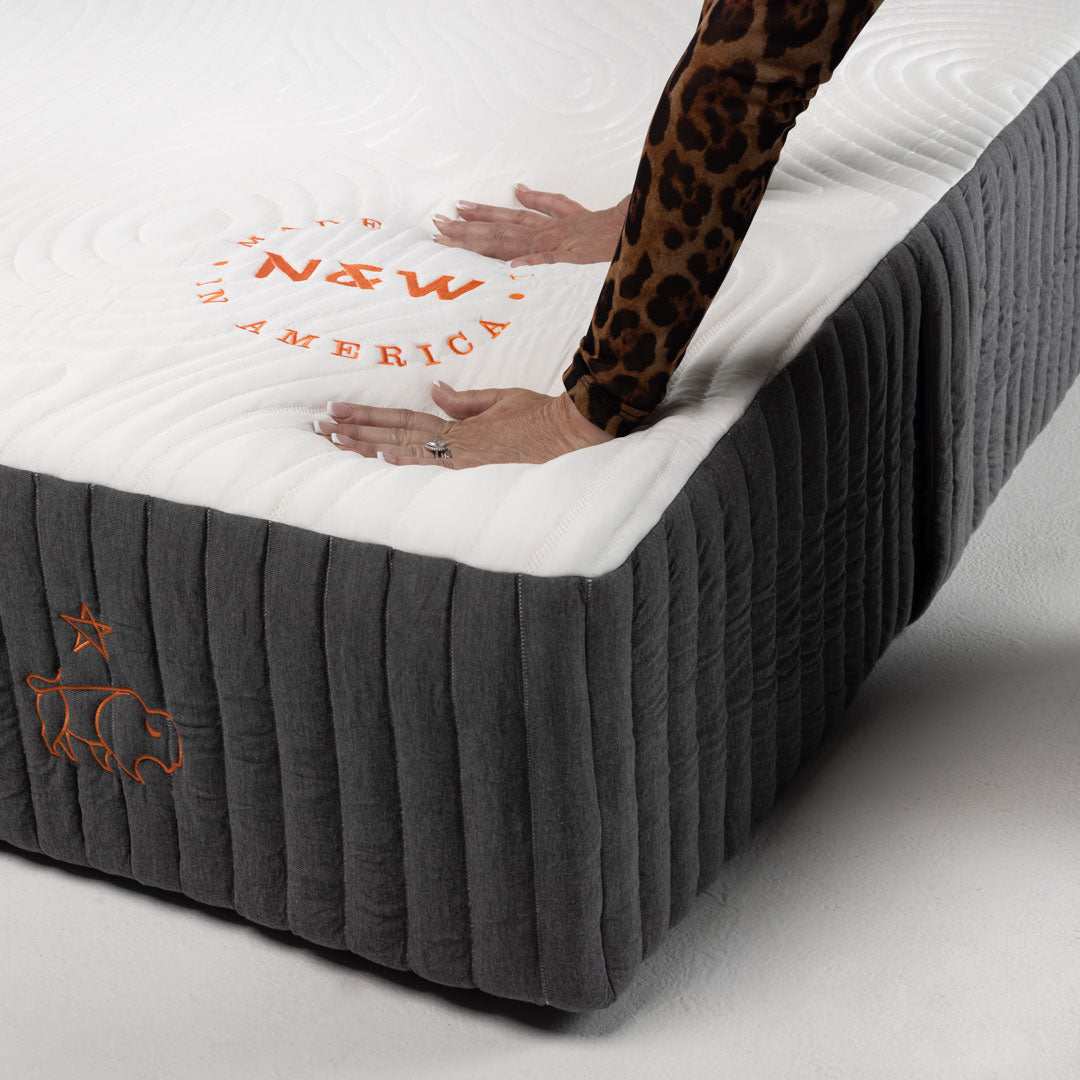
Every Nest & Wild mattress is 100% fiberglass-free, built with CertiPUR-US foams, GreenGuard Gold glue, and OEKO-TEX certified materials, and made in Tupelo, Mississippi. If non-toxic, certified materials are a top priority, that's the buy-with-confidence reason to choose the Luxury Hybrid — or browse the full Fiberglass-Free Mattress Hub to compare every option.
Who should choose memory foam, and who should choose a hybrid?
Choose memory foam for deep pressure relief and motion isolation if you run cool; choose a hybrid if you sleep hot, shift positions, are heavier, or have back pain. Here are the clean decision rules — including who each is not for.
Choose memory foam if you:
- Want the deepest shoulder and hip pressure relief
- Run cool (or keep a cool room)
- Share the bed and hate feeling a partner move
- Are lighter-bodied, or buying for a guest/kid's room on a tighter budget
Memory foam is NOT for you if you sleep hot, change positions often, or are a heavier combination sleeper — the heat and the "stuck" feel will work against you.
Choose a hybrid if you:
- Sleep hot and want coil airflow
- Switch between side and back overnight
- Are heavier and need coil support and sag resistance
- Have lower-back pain and want responsiveness plus adjustable-base options
A hybrid is NOT worth the premium if you're a light, cool-sleeping pure pressure-seeker — you'll pay more and move a heavier bed for benefits you won't use.
How strong is the evidence behind memory foam vs hybrid claims?
The firmness evidence is solid, but direct peer-reviewed memory-foam-vs-hybrid head-to-head trials in side sleepers are sparse — construction evidence is weaker than firmness evidence. That candor is the point: anyone promising a definitive "foam beats hybrid" verdict is overclaiming.
A 2019 biomechanical review in PeerJ concluded mattress design strongly influences comfort and health, but the field lacks standardized biomechanical methods and robust comparative trials across constructions such as foam and spring-based systems.
Practically, that means you should weight two things above marketing: get the firmness in the medium to medium-firm range, and trust your own in-home trial over any construction claim. The construction choice is a fit decision — heat, weight, and movement — not a proven clinical hierarchy.
How do I know which will feel right before I buy?
Watch for pressure, numbness, or morning back pain on your current bed, and buy only with a real in-home sleep trial and clear return policy. A preliminary 2024 8-week study in Health Science Reports of adults with nonclinical insomnia found a pressure-releasing medium-firm surface improved sleep, pain, mood, and fatigue — a reminder that the right surface, given time, changes how you feel.
Signs your current mattress is wrong for side sleeping:
- You wake with shoulder or hip pressure, or a numb/tingling arm.
- You wake with a lower-back ache that eases after you get up.
- You see visible body impressions or sagging where you sleep.
- You stack or fold pillows to prop up your waist or shoulder for support.
What to look for before you commit:
- A genuine multi-week in-home trial — your body needs weeks, not minutes, to judge a bed.
- An adjustment period for foam layers to break in (see our adjustment period guide).
- A clear, honest return policy so a wrong fit isn't a permanent mistake.
Frequently asked questions about memory foam vs hybrid for side sleepers: which is better?
Can a memory foam mattress really work for side sleepers?
Yes. Memory foam is often favored for side sleepers because it contours deeply around the shoulders and hips, reducing pressure buildup. NCOA notes it "can cradle your body and reduce pressure buildup in the hips and shoulders." The main caveats are heat retention and a slower, "stuck" feel when changing positions.
Which is better for hot sleepers, memory foam or hybrid?
Usually a hybrid. Its coil core improves airflow, so it tends to sleep cooler than traditional memory foam. But a hybrid with a thick, plush foam top can still trap heat, and cooling gel or copper only narrows the gap — the 2015 Sleep Health review found the evidence insufficient to name an optimal mattress temperature.
How firm should a mattress be for side sleeping without causing back pain?
Aim for medium to medium-firm. A 2015 systematic review of 24 trials linked medium-firm surfaces to better comfort and alignment, and a 2024 study found lower-back discomfort significantly worse on firm than medium-firm beds. Too firm creates shoulder/hip pressure; too soft allows the spine to sag.
Which is better for sciatica or lower-back pain?
Start with a medium-firm feel, since the NCBI evidence review found medium-firm may reduce back pain versus firmer beds. A responsive hybrid helps you shift without waking, and an adjustable base that elevates the legs offloads the lumbar spine. For persistent or radiating pain, consult a clinician before changing your setup.
Do these mattresses off-gas, and are they fiberglass-free?
Off-gassing is typically short-lived VOC release, and certifications like CertiPUR-US and GreenGuard Gold cap allowable emissions. Nest & Wild mattresses are 100% fiberglass-free, built with CertiPUR-US foams, GreenGuard Gold glue, and OEKO-TEX certified materials in Tupelo, Mississippi — unlike many budget beds that use fiberglass as a fire barrier.
Are hybrid mattresses worth the higher price for a side sleeper?
It depends on your situation. A hybrid is worth more if you sleep hot, shift positions, are heavier, or have back pain. For a light, cool-sleeping pure pressure-seeker — or a guest or kid's room — an all-foam mattress delivers the contouring you want for less money and less bulk.

Your decision rule, in one line
Get the firmness right first — medium to medium-firm — then match construction to your body and your heat. Hot sleeper, combination sleeper, heavier body, or lower-back pain? The fiberglass-free, Tupelo-made Luxury Hybrid is your balanced pick, and pairing it with an adjustable base addresses lumbar load directly. Cool-sleeping pure pressure-seeker, or buying for a guest or kid's room? The Original all-foam mattress gives you the deepest contour for less. And if certified, non-toxic materials are what you care about most, see all fiberglass-free mattresses — every one built in Tupelo, Mississippi, CertiPUR-US, GreenGuard Gold, and OEKO-TEX certified, so you can buy with confidence.